Wine · Wine region · Short entry
Crozes-Hermitage
Crozes-Hermitage
Crozes-Hermitage is the largest northern Rhône cru, surrounding the Hermitage hill on the left bank north of Valence across eleven Drôme communes. Granite slopes in the north give way to flat Quaternary terraces of rounded stones in the south. It makes red wine from Syrah and white wine from Marsanne and Roussanne.
From one commune to eleven
The commune appears as Crozis in 1240, Croisis in 1285 and Crosis in 1344, and as Crozes or Croses in the seventeenth century; it took the name Crozes-Hermitage by decree on 14 May 1920, after the famous hill next door. Growers rebuilt the vineyard after phylloxera from 1881, and syndicates (1890, 1927) and the Tain cooperative (1933) grew out of the crises of the 1920s. The AOC decree of 4 March 1937 covered only part of Crozes-Hermitage, excluding modern alluvium; in 1952 the area grew to eleven communes. After a ten-year review, a new parcel selection approved in June 1989 cut the potential area from 4,800 to 3,200 ha. The specification quotes an 1846 wine congress at Lyon comparing the wine with Hermitage: "if not a brother, certainly a first cousin".
Granite in the north, stones in the south
The area lies north of Valence, opposite Tournon, bounded by the Rhône to the west, the Herbasse to the east and the Isère to the south. In the north the Rhône cuts through "Tournon granite", the same rock as across the river in Saint-Joseph; its unstable granite sand is held on terraces with dry-stone walls. South and east the land is flatter, a staircase of Quaternary terraces of pebbles eroded from the Alps. The oldest and highest lie north of Mercurol and Chanos-Curson; some high points carry loess, and intermediate levels form the Coteau des Pends at Mercurol. The largest planted area lies on the lowest, youngest terrace, the Chassis, where rounded stones over soils with little water reserve can stress the vines. Part of Larnage has very white kaolin sands. South of Tain-l'Hermitage the Mediterranean influence is clearer, and Inter Rhône notes that wind is a feature of the river corridor.
Supple reds, two kinds of white
The specification says the contrast between north and south shows in the wines. Southern reds are pleasant, aromatic and well built without excess, for medium keeping; some hillside cuvées from the north have more structure and age longer. Reds are dark garnet, turning orange with age. Whites are pale with green tints. Depending on how growers manage malolactic fermentation, they are either intensely fruity, recalling citrus, and lively, to drink young, or more floral and spicy and fuller, improving with medium ageing. Next to Hermitage it describes suppler reds and more contrasted whites.
Syrah, Marsanne and Roussanne
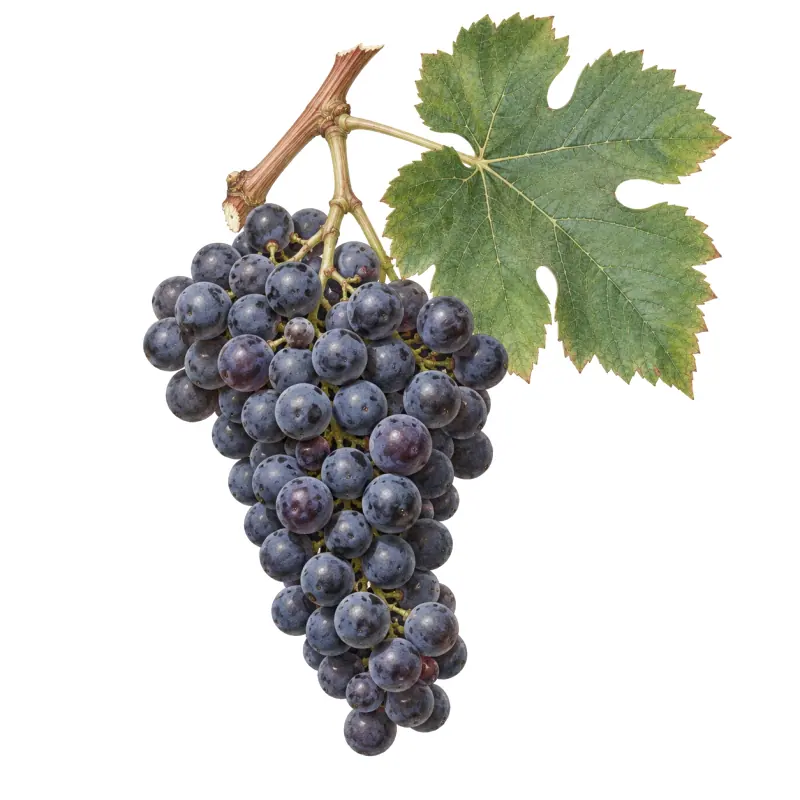
The AOC, also written Crozes-Ermitage, covers still red and white wine. Reds come from Syrah, at least 85% of each holding's vines, with Marsanne and Roussanne allowed only interplanted and up to 15% of the vines. Whites come from Marsanne and Roussanne. Syrah, sometimes called petite syrah, makes up about 90% of the plantings, and a local clone called syrah de Gervans is found throughout. The base yield is 45 hl/ha, or 40 hl/ha where rows are 2.50–2.75 m apart. In 2019 the AOC averaged 80,400 hl a year from 1,700 ha, made by 57 private cellars, two cooperatives and nine merchants: the largest of the northern Rhône.
How it connects
Wine region
- in Rhône Valley