Wine · Wine region · Short entry
Txakoli
Txakoli / Txakolina
Txakoli names a family of mostly white wines from the Basque Country, protected by three separate designations: Getariako Txakolina (all of Gipuzkoa), Bizkaiko Txakolina (all of Bizkaia) and Arabako Txakolina (the Ayala valley in northern Álava). All three rest on the local Hondarrabi Zuri (Ondarrabi Zuri) and Hondarrabi Beltza grapes and a wet Atlantic climate.
A coastal wine saved in the 1980s
The Getaria specification cites vines in the charter granted to San Sebastián by King Sancho of Navarre in 1180. In 1509 a guild of vine pruners formed in San Sebastián, and a ruling of 1520 by the Royal Chancery of Valladolid over "three and a half pipes of chacolí" uses the word "chacolín". By the nineteenth century Gipuzkoa's vines survived mainly at Getaria (35 ha) and Zarautz (4 ha), on pergolas, with the local Ondarrabi grapes. From 1980 local growers renewed vineyards and wineries; the designation was ratified by order of 6 April 1990 and extended from Aia, Getaria and Zarautz to all of Gipuzkoa in 2007. In Bizkaia, the Lekeitio ordinances of 1338 already exempt from tax the timber used for vine pergolas. For Álava, the rules cite vines at Retes de Tudela (Artziniega) in 864 and in the land of Ayala in 964; cultivation there almost died out in the 1980s.
Sea slopes and rain
In Gipuzkoa 95% of Getariako Txakolina comes from vineyards within 1 km of the sea. The climate is mild Atlantic with maritime influence: a mean of 13.4 °C, about 1,800 hours of clear sun, 1,600 mm of rain over about 185 days a year and no spring frost. The ground alternates hard layers of limestone and sandstone with soft marls and clay rocks, giving clay-loam and loam soils of about neutral pH. Dense vegetation protects them from erosion. Most vineyards are on slopes of 15-20% sheltered from north-west winds and facing the sun.
Bizkaia is a land of mid-height mountain chains (100-1,000 m) running north-west to south-east, with the main valleys of the Ibaizabal and the Butrón; vines sit on south-facing, moderate slopes, with 1,200 mm of rain, a mean of 12.4 °C and high humidity. Arabako Txakolina comes from the Ayala valley in the north of Álava, with about 899 mm of rain.
High acidity, moderate alcohol
The Getaria specification ties tartaric acidity above 7 g/l to the high rainfall, about 1,600 mm a year and 115 mm a month, and to mean temperatures of 18-20 °C late in ripening. Average alcohol of 11-11.5% comes from high leaf exposure on pergolas and the same late-season temperatures. South and south-west winds at the end of summer bring dry, warm weather that finishes ripening and gives a fresh, light txakoli. The rules describe the white as pale greenish yellow to golden, fresh, with green fruit and herbaceous aromas, balanced acidity, a fine sensation of carbon dioxide and a slightly bitter aftertaste. Fermentation on the lees under temperature control keeps part of the natural carbon dioxide. Pergolas 1.8 m high keep bunches airy and away from damp soil.
Three designations, one grape family
Getariako Txakolina is practically all white; red and rosé are residual. Recommended grapes are Ondarrabi Zuri (white) and Ondarrabi Beltza (red); authorised whites are Ondarrabi Zuri Zerratia or Petit Courbu, Izkiriota or Gros Manseng, Riesling and Chardonnay, limited together to 20% of each winery's vineyard. A varietal wine needs 85% of a recommended grape, and rosé at least 50% Ondarrabi Beltza. Minimum alcohol is 9.5% and maximum yield 13,000 kg/ha.
Bizkaiko Txakolina and Arabako Txakolina treat Hondarrabi Zuri, Hondarrabi Beltza and Hondarrabi Zuri Zerratia (Petit Courbu) as recommended, and authorise Gros Manseng, Petit Manseng, Sauvignon Blanc, Riesling, Chardonnay, Pinot Noir and Cabernet Franc; Bizkaia also allows Mune Mahatsa (Folle Blanche). Both rules provide for sparkling wines under the Bizkaia and Álava names. Each designation has its own boundaries and specification.
Classification
- Getariako TxakolinaAll of Gipuzkoa since 2007; recommended grapes Ondarrabi Zuri and Ondarrabi Beltza.
- Bizkaiko TxakolinaAny municipality of Bizkaia; recommended grapes Hondarrabi Zuri, Hondarrabi Beltza and Hondarrabi Zuri Zerratia (Petit Courbu).
- Arabako TxakolinaAmurrio, Artziniega, Ayala/Aiara, Laudio/Llodio and Okondo; same recommended grapes as Bizkaia.
How it connects
Grape variety
- grows Petit Courbu
Recipe
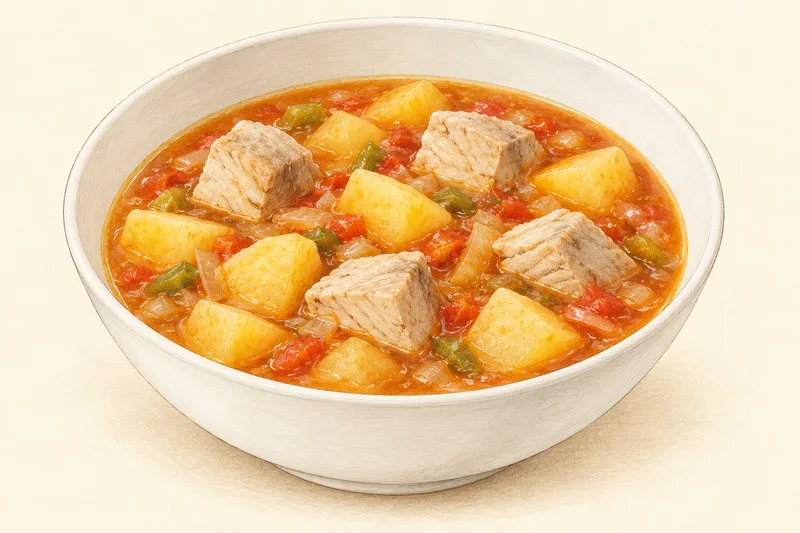
- pairs with Marmitako