Wine · Wine region · Short entry
Châteauneuf-du-Pape
Châteauneuf-du-Pape
Châteauneuf-du-Pape makes red and white wines on the Rhône's left bank about 15 km north of Avignon, across five Vaucluse communes. Eighteen grape varieties are allowed, with Grenache dominant, and the rounded Alpine stones of its terraces are its best-known soils. A 1929 court ruling won by its growers led to its 1936 decree, one of the first French AOCs.
The popes' vineyard and the first AOC rules
The vineyard probably dates back at least to the eleventh century, but grew from the fourteenth, when the papacy settled at Avignon. John XXII (1316–1334), whose estate this was, built the castle whose ruins remain and promoted the wine. Vines spread again in the eighteenth century; in 1750 one family's 40 hl went to France, Italy, Germany, England and the United States. In 1817 the town council banned mixing local wine with outside fruit. About 1870 Joseph Ducos studied what each grape brings, and his work is the basis of the grape list. In 1923 growers formed a syndicate with Baron Le Roy de Boiseaumarié, and a judgment of the Avignon court on 28 June 1929 set the delimitation, grapes, minimum alcohol and sorting of the grapes. The AOC decree followed on 15 May 1936, and the specification calls these rules the first example later followed by other French regions.
Galets roulés, sand and sandstone
The area lies on the left bank about 15 km north of Avignon, west of the Comtat Venaissin plain. Marine Miocene molasse rests against massive Urgonian limestone in the west, forming a plateau at about 100 m. At the end of the Pliocene the Rhône covered it with coarse alluvium: the Villafranchian terraces of rounded Alpine stones, often large and thick, mixed with reddish clay. In the north-east the molasse shows through in sandy soils, safres and red sandstone of the Comtat. The famous rounded stones therefore describe part of the vineyard, not every parcel. The Mediterranean climate is shaped by the cold, dry Mistral, which brings sunshine and lowers rainfall to under 650 mm a year; with about 2,800 hours of sun, the specification calls it one of the driest parts of the Rhône valley.
Stones that keep the heat
The specification explains that the rounded stones store heat by day and give it back at night, a phenomenon called "caïau frejaü", helping full ripening and concentration of the berries. The dry, Mistral-swept climate limits fungal disease and keeps the grapes healthy. It describes the reds as powerful and structured, well suited to ageing, complex and long, and the whites, mainly from Grenache Blanc, Clairette and Roussanne, as ample, very expressive and fresh. Grapes from several varieties, often planted together in one parcel, are blended.
Eighteen grapes, low yields
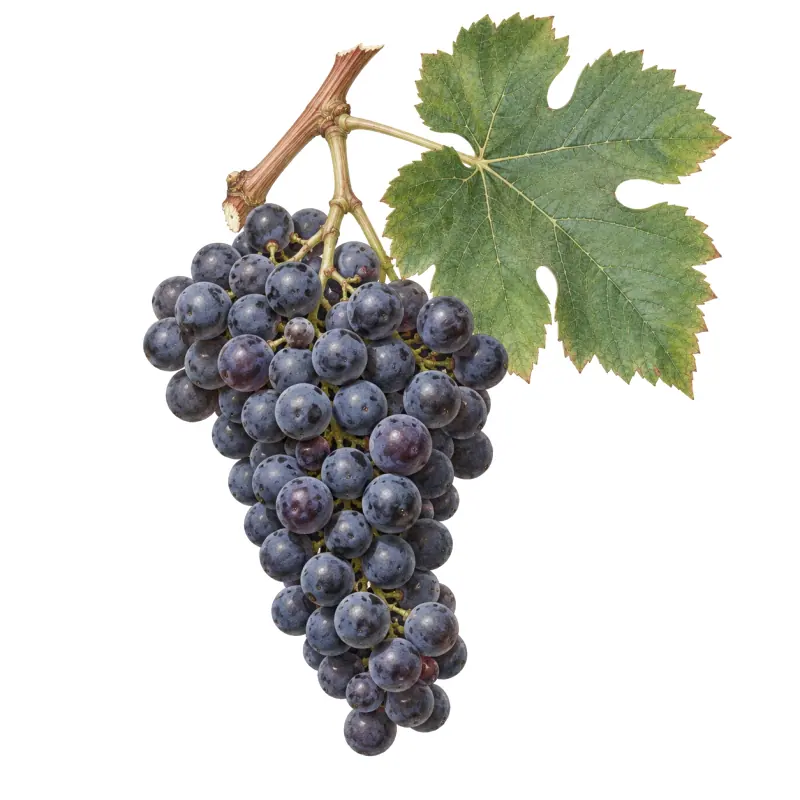
The AOC covers dry still red and white wine from Bédarrides, Châteauneuf-du-Pape, Courthézon, Orange and Sorgues. The same list of 18 varieties serves both colours: Bourboulenc, Brun Argenté (locally Vaccarèse), Cinsault, Clairette, Clairette Rose, Counoise, Grenache Blanc, Grenache Gris, Grenache, Mourvèdre, Muscardin, Picardan, Piquepoul Blanc, Piquepoul Gris, Piquepoul Noir, Roussanne, Syrah and Terret Noir. Grenache dominates the vineyard. The base yield is 35 hl/ha, harvesting by hand and sorting are compulsory, and Grenache, Mourvèdre, Piquepoul Noir and Terret Noir must be trained as bush vines and short-pruned. In 2010 about 3,200 ha were farmed by 320 holdings, producing about 100,000 hl, 95% of it red.
How it connects
Wine region
- in Rhône Valley
Grape variety
- grows Syrah
- grows Clairette
- grows Roussanne
- grows Bourboulenc
- grows Garnacha Tinta