Wine · Wine region · Short entry
Cannonau di Sardegna
Cannonau di Sardegna
A DOC for wine from at least 85% Cannonau grown anywhere in Sardinia. Its types are red, rosé, Riserva, Passito and Liquoroso; the Classico, from the provinces of Nuoro and Ogliastra, needs 90% Cannonau. The subzones Oliena (or Nepente di Oliena), Capo Ferrato and Jerzu may appear on labels.
Cañonates in the seventeenth century
The rules repeat the common theory that the vine reached the western Mediterranean from the Caucasus by way of Mesopotamia, Anatolia and Egypt, and Sardinia with the Phoenicians, while wild Vitis vinifera sylvestris grows across the island. They call the Cannonau's presence immemorial. Written traces start in the seventeenth century: Martin Carrillo, visitor for the king, in 1612 and the Franciscan Giorgio Aleo in 1677 wrote of fine 'Cañonates' wines made all over the island. Manca dell'Arca named the Cannonau in the eighteenth century, and Moris in the nineteenth classified it as 'Vitis praestans'. In the mid-1800s the priest Vittorio Angius, describing viticulture commune by commune, found Cannonau the most widespread vine in Sardinia. The DOC was approved on 21 July 1972; the regional agency's summary reproduces the rules as last amended in 2014.
An island no more than 53 km from the sea
The zone is the whole of Sardinia, 24,090 km², the second island of the Mediterranean. No point is more than 53 km from the sea, so no area has a continental climate. Winters are mild, summers stable and almost rainless, and wind blows in every season, most often the mistral. Rain averages 775 mm: about 1,000 mm in the centre-north, no more than 600 mm on coasts and plains and down to 400 mm in the south. Over half the land lies below 300 m, but rugged reliefs make the island mountainous; in the warm-temperate belt, which covers most of it, the vine grows well up to 600 m.
Almost every geological era is present: granites in Gallura, schists in the centre, Mesozoic dolomitic limestones at Oliena and Monte Albo, Tertiary trachytes and andesites, Miocene sediments, Quaternary basalts and the alluvium of the Campidano. The soils follow the rock: alluvial, calcareous, trachytic, basaltic, schistose, and sandy, acid soils from granite.
One grape, many wines
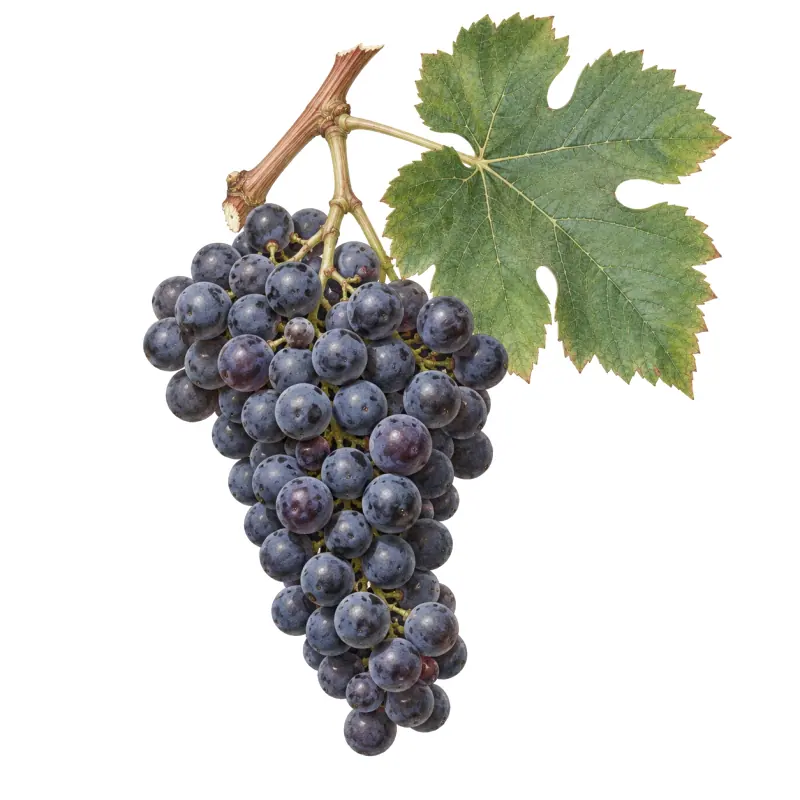
The rules say Cannonau has no special needs of soil or climate, which let it spread across the island, and that its wide adaptability gives very different wines. They describe a medium, compact bunch with thin, firm, violet-black skins, usually trained as alberello and ripening late in the season. The rosé is bright pink with rose, violet and cherry; the red is ruby with ripe red and black fruit (cherry, myrtle, plum, blackberry), pepper and Mediterranean herbs, sapid and lightly tannic; the Riserva turns garnet, with dried rose petal, jam, prune, clove and cinnamon-vanilla.
From rosato to Liquoroso
The DOC needs at least 85% Cannonau, which the atlas grape record treats as Garnacha, with other non-aromatic red grapes suited to Sardinia up to 15%; the Classico, limited to the provinces of Nuoro and Ogliastra, needs 90%. Red wines may be sold from 1 April after the harvest and the rosé from 1 January. The Riserva ages at least two years from 1 November of the harvest year, six months of them in wood; the Classico also ages two years, at least 12 months in wood. The Passito may be sold from 1 November of the year after the harvest, and the Liquoroso from the same date after at least six months in wooden casks. The vintage must appear on the label.
Classification
- Cannonau di Sardegna DOCRed released from 1 April after the harvest, rosé from 1 January. Subzones: Oliena or Nepente di Oliena, Capo Ferrato, Jerzu.
- RiservaAt least 2 years from 1 November of the harvest year, 6 months in wood.
- ClassicoNuoro and Ogliastra only; at least 90% Cannonau; 2 years' ageing, at least 12 months in wood.
How it connects
Grape variety
- grows Garnacha Tinta
Wine region
- related Vermentino di Gallura
Continue exploring
- CountryItaly107 entries in the atlas so far
- Grape varietyGarnacha Tinta
- Wine regionVermentino di GalluraTempio Pausania, Italy
- Grape varietyVermentino
- Wine regionBandolBandol, France
- Wine regionBarossa ValleyTanunda, Australia
- Wine regionChâteauneuf-du-PapeChâteauneuf-du-Pape, France
- Wine regionCorsicaBastia, France
- Wine regionGigondasGigondas, France
- Wine regionLanguedocNîmes, France