
Wine · Wine region · Short entry
Brunello di Montalcino
Brunello di Montalcino
A DOCG for red wine made only from Sangiovese, locally called Brunello, within the commune of Montalcino, 40 km south of Siena. It must age at least two years in oak and may not be sold before 1 January of the fifth year after the vintage, or the sixth for the Riserva. Rosso di Montalcino, from the same commune, is a separate DOC.
Clemente Santi's Vino Scelto
The rules say Montalcino's gift for good wine has been known for centuries. Medieval statutes already set the start of the harvest. During the siege of 1553 wine never ran short, and Blaise de Montluc, defending the walls, reddened his face with it to hide his hardship. Leandro Alberti praised the good wines of its hills, the grand-ducal auditor Bartolomeo Gherardini recorded 6,050 some of 'strong wine' in 1676-1677, and Charles Thompson wrote in 1744 that Montalcino was known for little except the goodness of its wines.
The rules name Clemente Santi as the forerunner of Brunello: in 1869 his Vino Scelto (Brunello) of the 1865 vintage won a silver medal. In the early 1900s Riccardo Paccagnini's Brunello won national and international prizes. Production then declined, and a few producers kept it alive between the wars; Brunello was shown at Siena in 1932, 1933 and 1935. After the Second World War producers agreed rules for the wine. It became a DOC in 1966 and a DOCG in 1980.
A square hill between three rivers
The production area is the commune of Montalcino in south-east Tuscany: 243.62 km², almost square with sides of about 15 km, bounded by the valleys of the Orcia, Asso and Ombrone. It rises from about 120 m along the rivers to about 650 m at Poggio Civitella. Formed in different geological periods, the hill has many soil settings: sandstones, sometimes mixed with limestone, alberese and galestro, and mixed textures that lean now to sand, now to clay. The consortium describes looser ground lower down and stonier marl and limestone higher up.
The sea lies 40 km to the west and the Apennines about 100 km to the east. The climate is Mediterranean and rather dry, with continental traits: about 700 mm of rain, mostly in spring and autumn, and snow possible above 400 m. The middle slopes escape fog and late frosts, frequent wind keeps the vines healthy, and the growing season is mild with many clear days.
Poor soils, slow ripening
The rules link the wine to poor, calcareous soils with little organic matter and limited water, which hold Sangiovese to moderate vigour and small crops. Spring rain builds a water reserve; growth slows in summer as the soil dries; late summer and early autumn turn cooler, with marked day-night swings from position and height. With wind and sun, this gives fully ripe, healthy grapes. The wine is described as clear and bright, intense ruby turning garnet, with an intense, ample, ethereal nose of undergrowth, aromatic wood, small fruits, light vanilla and mixed preserves, and an elegant, harmonious, dry body with long persistence. The rules say it keeps for ten to thirty years depending on the vintage, and should be served at about 18-20 °C.
Only Sangiovese, five years before sale
Brunello must come only from Sangiovese. New plantings since 2016 need 4,000 vines/ha, and the yield is at most 8 t/ha, or 7 t/ha with the mention 'vigna'. The wine must age at least 24 months in oak of any size and then at least 4 months in bottle, or 6 for the Riserva. It may not be sold before 1 January of the year after the end of five years counted from the vintage, six for the Riserva, and must reach 12.5% alcohol.
Winemaking, oak ageing, bottling and bottle ageing must all take place in the commune, and only dark Bordeaux-shaped bottles are allowed. Brunello may be downgraded to Rosso di Montalcino, which the consortium describes as a separate, earlier-released DOC from the same commune rather than a lower tier of Brunello.
Classification
- Brunello di Montalcino DOCGAt least 24 months in oak and 4 in bottle; not sold before 1 January after five years counted from the vintage. Minimum alcohol 12.5%. Maximum yield 8 t/ha (7 t/ha with 'vigna').
- RiservaAt least 6 months in bottle; not sold before 1 January after six years counted from the vintage.
How it connects
Place
- related Tuscany In preparation
Grape variety
- grows Sangiovese
Continue exploring
- CountryItaly107 entries in the atlas so far
- Grape varietySangiovese
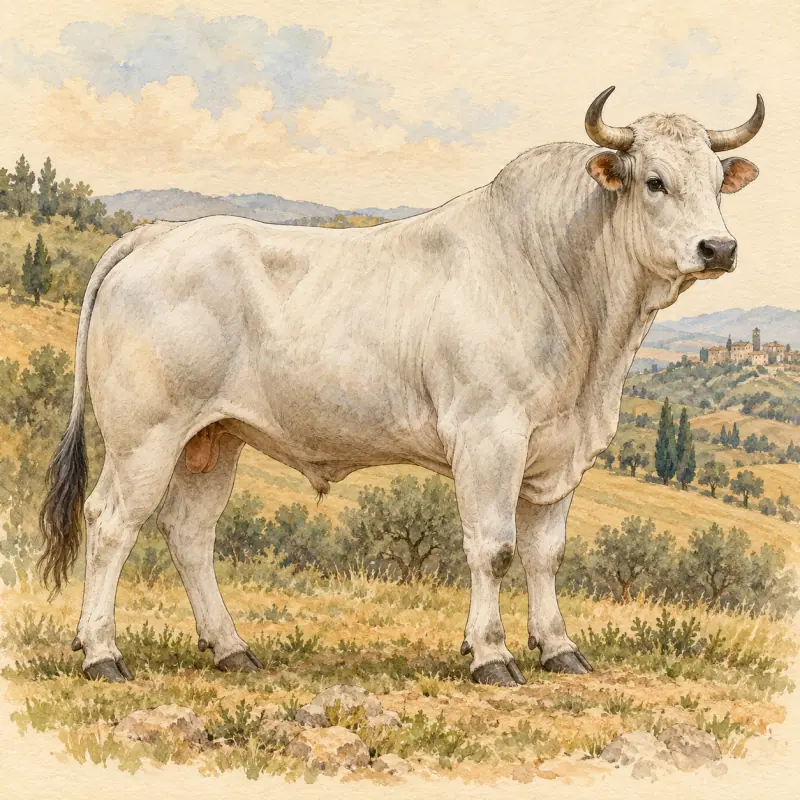 BreedChianina
- Grape varietyMontepulciano
- Wine regionBolgheriCastagneto Carducci, Italy
- Wine regionCarmignanoCarmignano, Italy
- Wine regionChianti ClassicoGreve in Chianti, Italy
- Wine regionVernaccia di San GimignanoSan Gimignano, Italy
- Wine regionVino Nobile di MontepulcianoMontepulciano, Italy