
Wine · Wine region · Short entry
Bolgheri
Bolgheri
A DOC on the Tuscan coast covering the commune of Castagneto Carducci east of the Via Aurelia, in the province of Livorno. Its rules allow white, Vermentino, Sauvignon, rosé, red and red Superiore wines, the reds based freely on Cabernet Sauvignon, Merlot and Cabernet Franc. Bolgheri Sassicaia, first a subzone, has its own DOC.
The Gherardesca vineyards and Sassicaia
The rules record vines here from the Etruscans and Romans, citing Pliny and Rutilius Namatianus, and in the Middle Ages on monastic land. At the end of the 1600s the Gherardesca family began growing vines at San Guido and Belvedere; in the 1700s Segalari was known for wine, and from 1790 new vineyards were planted near Bolgheri. In the first half of the 1800s Count Guido Alberto della Gherardesca hired experts such as Giuseppe Mazzanti and chose French varieties, among them Gamay, Cabernet and Syrah. Experimental vineyards were planted in 1816 at Capanne di Castiglioncello, where the first Sassicaia vineyard later grew.
Phylloxera in the early 1900s forced a rethink. From 1944 Marchese Mario Incisa della Rocchetta planted Bordeaux varieties, first on high, east-facing hills, until it became clear that the foothills and plain, and the sea air, suited them better. In 1978 Decanter placed Sassicaia first in a tasting of the world's Cabernets. Bolgheri became a DOC on 1 August 1983, and Sassicaia was added as a subzone in 1994.
Between the hills and the Tyrrhenian
The zone is the commune of Castagneto Carducci east of the SS1 Aurelia; the strip between the road and the sea is excluded. A line of hills running north-south at 250-400 m, roughly parallel to the coast, closes its eastern edge. Below it lies the foothill belt where the vineyards are, and to the west the Tyrrhenian Sea; the Cecina and Cornia rivers lie to the north and south. The hills shelter the vines in winter, while in summer the rivers and the sea feed steady air that tempers the heat. Mean temperatures are 9.6 °C minimum, 19.4 °C maximum and 14.5 °C overall, with 584 mm of rain and a water deficit of 205 mm; the Huglin index is 2,444 and the Winkler index 1,747.
A zoning study led by Professor Attilio Scienza found 27 soil units in 16 landscape units, ranging from sand to clay and silty clay, weakly alkaline to alkaline. The consortium describes the same close-grained mosaic of marine and river deposits, with sand, clay and stones changing over short distances.
One grape for each soil
The rules attribute regular, complete ripening to the shape of the land and its climate, and the complexity and length of the wines to the variety of soils. Growers choose the variety for each landscape unit and soil type, keeping the soils best suited to reds apart from those suited to whites, and the local climates of slope and exposure are monitored; annual analyses of the wines follow the weather of each year. The consortium says Bolgheri has no single dominant grape because its varied sites suit several varieties. White and rosé wines are made to be fresh, sapid and harmonious; the Superiore is the more structured red, with obligatory ageing in cask and bottle.
Free blends, and a separate Sassicaia
Bolgheri bianco may use Vermentino, Sauvignon and Viognier in any proportion, with other white grapes up to 40%; the Vermentino and Sauvignon versions need 85% of their variety. The rosso, rosato and rosso Superiore may use Cabernet Sauvignon, Merlot and Cabernet Franc from 0 to 100%, Syrah and Sangiovese up to 50% each, and other red grapes up to 30%. The rosso may be sold from 1 September of the year after the harvest; the Superiore ages at least two years from 1 January after the vintage, one of them in oak barrels. All winemaking and bottling take place in Castagneto Carducci.
Bolgheri Sassicaia, a DOC by decree of 5 November 1994, is a single red of at least 80% Cabernet Sauvignon, aged at least two years, 18 months of them in oak barrels of no more than 225 litres.
Classification
- Bolgheri DOC rossoReleased from 1 September of the year after the harvest.
- Bolgheri rosso SuperioreAt least 2 years' ageing from 1 January after the harvest, 1 of them in oak barrels.
- Bolgheri Sassicaia DOCSeparate DOC (1994): at least 80% Cabernet Sauvignon, 2 years' ageing with 18 months in oak barrels of up to 225 l.
How it connects
Place
- related Tuscany In preparation
Continue exploring
- CountryItaly107 entries in the atlas so far
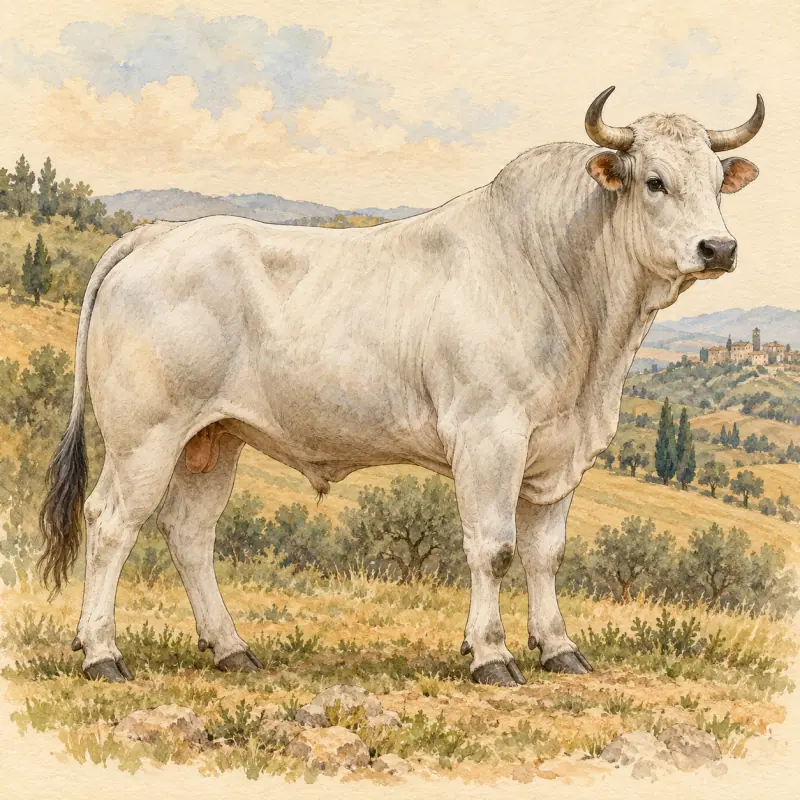 BreedChianina
- Wine regionBrunello di MontalcinoMontalcino, Italy
- Wine regionCarmignanoCarmignano, Italy
- Wine regionChianti ClassicoGreve in Chianti, Italy
- Wine regionVernaccia di San GimignanoSan Gimignano, Italy
- Wine regionVino Nobile di MontepulcianoMontepulciano, Italy