
Wine · Wine region · Short entry
Beaujolais
Beaujolais
Beaujolais is a wine-growing region of hills between Lyon and Mâcon, about 55 km from north to south, planted almost entirely with Gamay. Its twelve appellations range from Beaujolais and Beaujolais-Villages to ten crus in the granite north. A soil survey from 2009 to 2017 recorded more than 300 soil profiles across the vineyard.
From the lords of Beaujeu to Beaujolais Nouveau
The specification quotes Viala and Vermorel (1902): vines were established for good in the Lyonnais in the third century, and in 280 AD the emperor Probus allowed the Gauls to plant vines near Lyon. Inter Beaujolais tells that in the tenth century Beraud, first lord of Beaujeu, is said to have given a plot of vines near Villié-Morgon; the lordship of Beaujeu gave the region its name. Wine stayed a minor crop until the seventeenth century, when Beaujolais became the main supplier of the taverns of Lyon.
In the nineteenth century the south made light wines for Lyon and the north more concentrated wines for Mâcon and northern France. The first cooperative opened at Fleurie in 1927. The AOC Beaujolais was recognised by the decree of 12 September 1937; Beaujolais-Villages followed on 21 April 1950. Early sales of new wine were authorised on 13 November 1951, and since 1985 Beaujolais Nouveau has been released on the third Thursday of November. In 2018 UNESCO named the Beaujolais a Global Geopark.
Two geologies, one sheltered slope
The vineyard lies on the eastern edge of the Massif Central above the Saône valley, 55 km long and 15–20 km wide, at 180–550 m. The specification distinguishes two families of rock. In the north, Palaeozoic granites, porphyries, schists and volcano-sedimentary rocks form rounded hills and weather into acid sandy or clay soils. In the south, younger Triassic and Jurassic limestones form steeper, elongated ridges with deeper, more clayey soils. Quaternary terraces and fans cover the foot of the slopes, which face mainly east and south. A survey from 2009 to 2017 covered 32,073 ha and described more than 300 soil profiles.
The climate is oceanic, with continental influences (summer storms, freezing fog in winter) and southern ones (summer heat, rain peaks in spring and autumn). The Monts du Beaujolais block west winds, and their foehn effect dries the air, reducing cloud and rain. The Saône valley brings southern air and light.
What the place gives the wine
The specification ties wine style to the two geologies. In the north, on acid soils, wines are rather powerful and deeply coloured; in the south, on mostly limestone ground, they are fruitier and lighter. Clay soils of the Beaujolais appellation give colourful, supple wines, and the sandy soils of crystalline rock reserved for Beaujolais-Villages give balanced wines with long aromatic persistence. Plain Beaujolais red is described as light in colour, fruity and floral, to drink young; Villages wines as deeper and more structured, able to keep several years. Growers use a vinification inspired by semi-carbonic maceration to keep the fruit, and Inter Beaujolais lists raspberry, wild strawberry, blackberry and black cherry among Gamay's aromas.
Grapes and appellations
Gamay is the main grape for reds and rosés in the Beaujolais appellation, with several accessory varieties allowed; whites are made only from Chardonnay. Inter Beaujolais gives about 13,500 ha across the 12 AOCs, 97% Gamay. The Beaujolais appellation lies mainly in the south and Beaujolais-Villages in the northern half; they are the only two allowed to make Beaujolais Nouveau. The ten crus in the north are Brouilly, Chénas, Chiroubles, Côte de Brouilly, Fleurie, Juliénas, Morgon, Moulin-à-Vent, Régnié and Saint-Amour. Each is a distinct delimited appellation; the broad region is not one uniform set of production rules.
How it connects
Grape variety
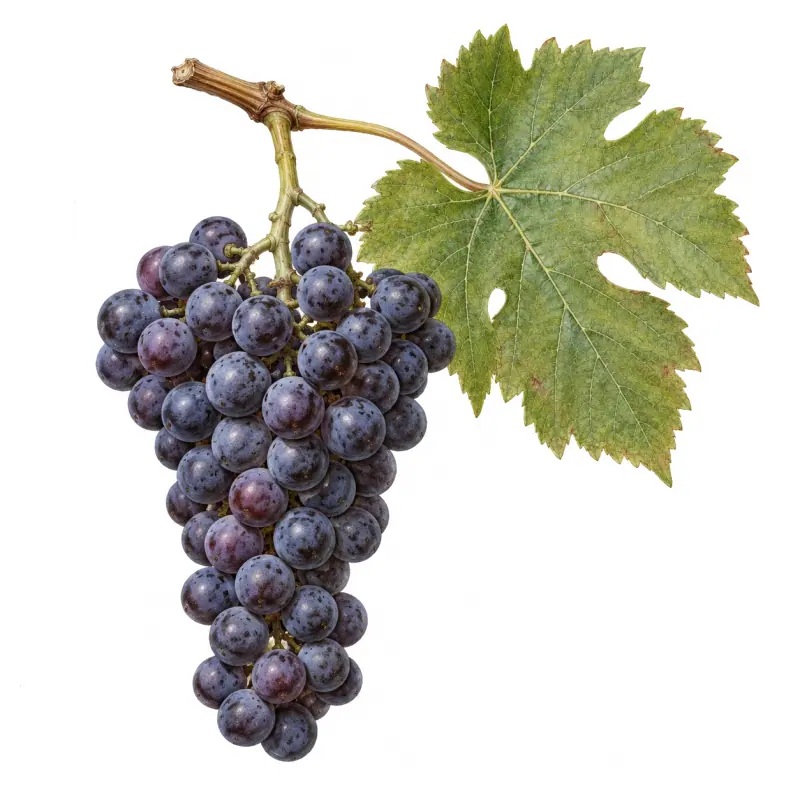
- grows Gamay
Recipe
- pairs with Pommes de terre à la lyonnaise
Wine region
- in Morgon
- in Moulin-à-Vent
Continue exploring
- CountryFrance162 entries in the atlas so far
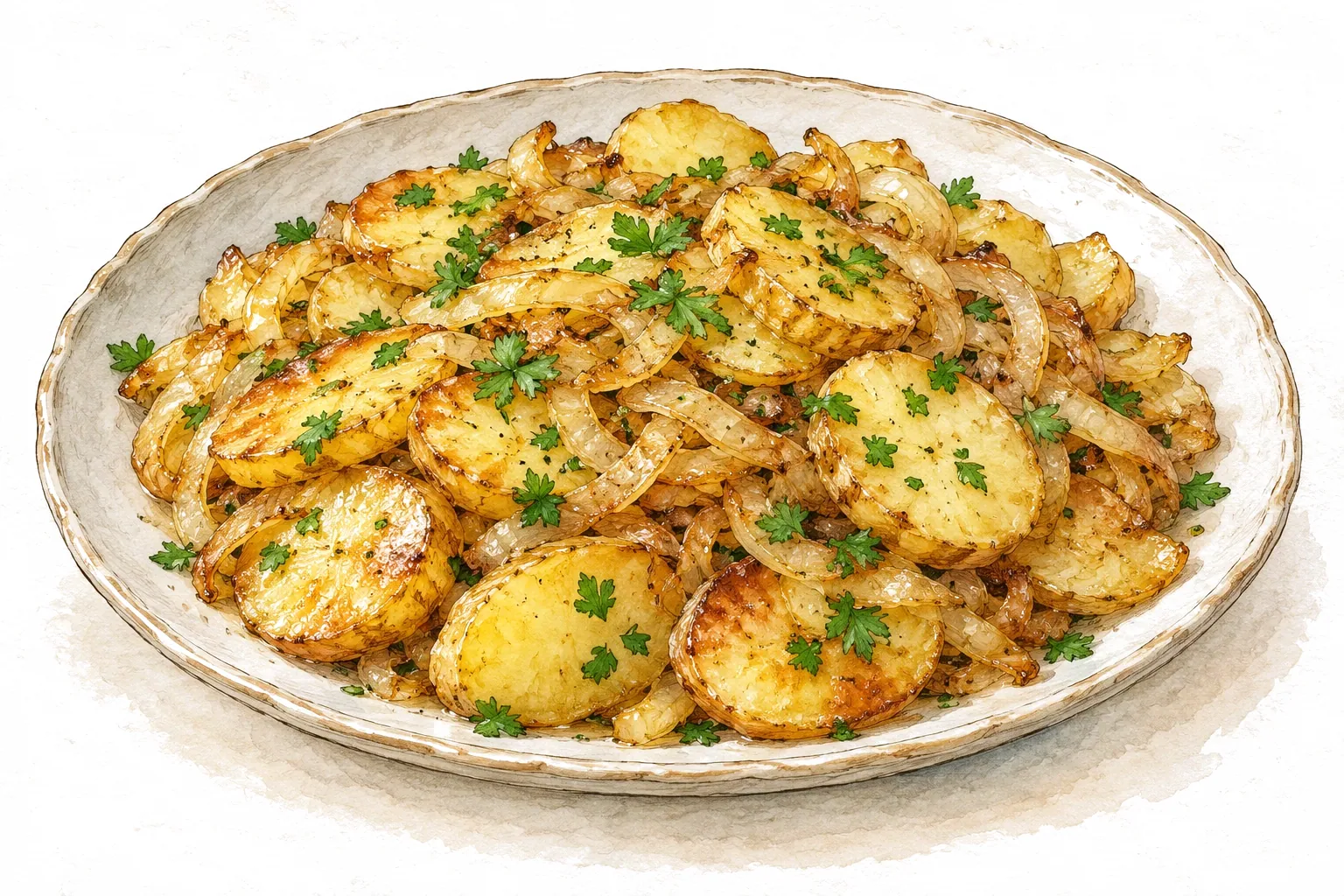 RecipePommes de terre à la lyonnaiseLyon, France
- Grape varietyGamay
- Wine regionMorgonVillié-Morgon, France
- Wine regionMoulin-à-VentRomanèche-Thorins, France
 StoryThe Cistercians and the Clos de VougeotVougeot, France
 PotatoBelle de Fontenay
 PotatoCharlotte
 PotatoLa Ratte
 Grape varietyPinot Noir