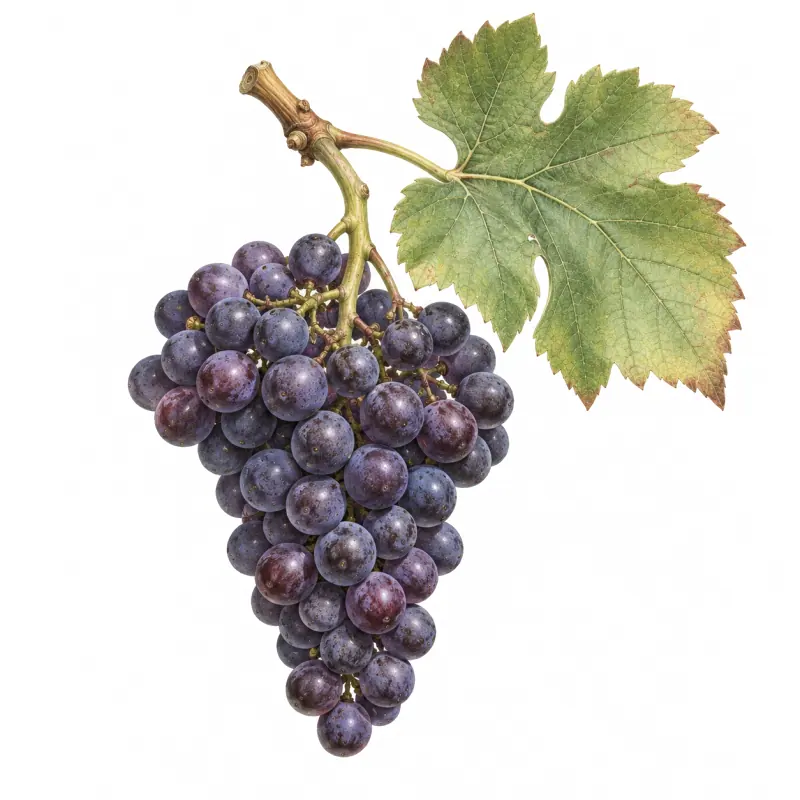
Wine · Wine region · Short entry
Nahe
Nahe
Nahe is a German protected designation of origin roughly in the triangle of Bingen, Alsenz and Monzingen, along the Nahe, the Glan and the Alsenz below the Hunsrück. Devonian slate, red Rotliegend sandstone, volcanic latite and andesite and Tertiary sands give it a wider range of rocks than any other German region, and its specification links a distinct aroma to each. Riesling covers about 29% of its 4,240 ha.
From Lorsch charters to an independent region
Weinland Nahe, the regional wine body, points to wine glasses and pruning knives in the Römerhalle at Bad Kreuznach as evidence of wine drinking in the Roman villas. From the early Middle Ages monasteries grew vines systematically; the oldest charter, of the abbey of Lorsch in 766, names the village of Norheim. The body names the "Monzinger Feuerwein", around 1500, as the Nahe's first export wine, loaded onto Rhine ships at the crane of Bingen, and dates to the same period the oldest surviving vines in Germany, of Weißer Orleans.
From 1901 a Prussian state domain near Niederhausen worked to raise standards; it is now Gut Hermannsberg. Until 1971 Nahe wine was sold as Rhine wine; since then the Nahe has been a region in its own right. Nahe estates had joined the forerunner of the VDP by 1925, and in 1997 the VDP Nahe adopted a Riesling statute that allows site names only for Riesling from the best defined vineyards.
The whole rock cycle in one valley
The specification places the region roughly in the triangle Bingen–Alsenz–Monzingen, across three natural units: foothills of the Hunsrück (Soonwald), the northern Upper Rhine lowland with the lower Nahe hills and plain, and the Saar-Nahe uplands in the south. Vineyards lie at about 210 m on average with a mean gradient of 12.5%, and include steep sites such as the Rotenfels at Bad Münster am Stein and the Steinberg at Niederhausen.
The oldest rocks are Devonian, both marine sandstones, slates and quartzites and metamorphic greenschist and phyllite. By far the most widespread are Rotliegend rocks, including volcanic latite, andesite and basalt. Vines also root in Tertiary river and coastal sands and marine marls. The German Wine Institute says the full rock cycle of igneous, sedimentary and metamorphic rock is present. The mean temperature is 9.3 °C, 13.8 °C in the growing season, and about 580 mm of rain falls; the institute adds that the high Hunsrück shelters the valley from cold winds.
An aroma for each rock
The specification says the variety of soil types is found only on the Nahe and shapes its wines. White wines from Devonian soils have peach and apricot notes with marked fruit acidity; from the dark calcareous claystone of the lower Rotliegend, yellow apple with a spicy, herbal note; from light sandstone, green apple, citrus and gooseberry with firm acidity; from the upper Rotliegend, apricot, honeydew melon, mango and dried fruit. Sand and gravel give lighter, delicate wines smelling of lemon, grapefruit and yellow apple. Red wines are light to dark red with cherry, dried fruit and blueberry. The German Wine Institute links volcanic and weathered-stone steep sites to Riesling of finesse and light spice.
Must weights and grapes
Nahe is a protected designation of origin for Qualitätswein, Prädikatswein, Sekt b.A. and Qualitätsperlwein b.A.; Classic and Weißherbst are among the terms listed. The 2011 technical file sets a maximum yield of 105 hl/ha and minimum must weights for Qualitätswein of 57° Oechsle for Riesling, 68° for Dornfelder and 60° for other grapes. Kabinett needs 73° for all grapes. Spätlese needs 78° for Riesling, 82° for Müller-Thurgau, Silvaner and red grapes and 87° for other whites; Auslese needs 85° for Riesling, 92° for Müller-Thurgau, Silvaner and red grapes and 95° for other whites. Beerenauslese and Eiswein need 120° and Trockenbeerenauslese 150°.
The German Wine Institute gives 4,240 ha in one district and, for 2022, 77% white grapes: Riesling 29.2%, Müller-Thurgau 11.4%, Pinot Gris 9.1% and Pinot Blanc 7.7%, with Dornfelder (9%) and Spätburgunder (6.9%) the main reds. It says flatter loam, loess and sand sites give lighter Müller-Thurgau and that Silvaner grows on many soils.
Classification
- Nahe g.U. (Qualitätswein)Minimum must weight 57° Oechsle for Riesling, 68° for Dornfelder, 60° otherwise. Maximum yield 105 hl/ha.
- PrädikatsweinKabinett 73°; Spätlese 78° for Riesling, 82° for Müller-Thurgau, Silvaner and reds, 87° for other whites; Auslese 85° for Riesling; Beerenauslese and Eiswein 120°; Trockenbeerenauslese 150°.
How it connects
Wine region
- in Germany
Continue exploring
- CountryGermany20 entries in the atlas so far
- Wine regionGermanyGermany
- Wine regionAhrBad Neuenahr-Ahrweiler, Germany
- Wine regionBadenFreiburg im Breisgau, Germany
- Wine regionFrankenWürzburg, Germany
- Wine regionMoselBernkastel-Kues, Germany
- Wine regionPfalzNeustadt an der Weinstraße, Germany
- Wine regionRheingauEltville am Rhein, Germany
- Wine regionRheinhessenNierstein, Germany
- Wine regionSaale-UnstrutFreyburg (Unstrut), Germany