
Wine · Wine region · Short entry
Ahr
Ahr
Ahr is one of Germany's smallest wine regions, with 535 ha of vines in 2025 along about 18 km of the Ahr valley between Altenahr and Bad Neuenahr-Ahrweiler in northern Rhineland-Palatinate. Red grapes cover 79% of the area and Spätburgunder alone about two thirds, the highest red share of any German region. The vines grow mostly on steep slopes of Devonian greywacke and slate.
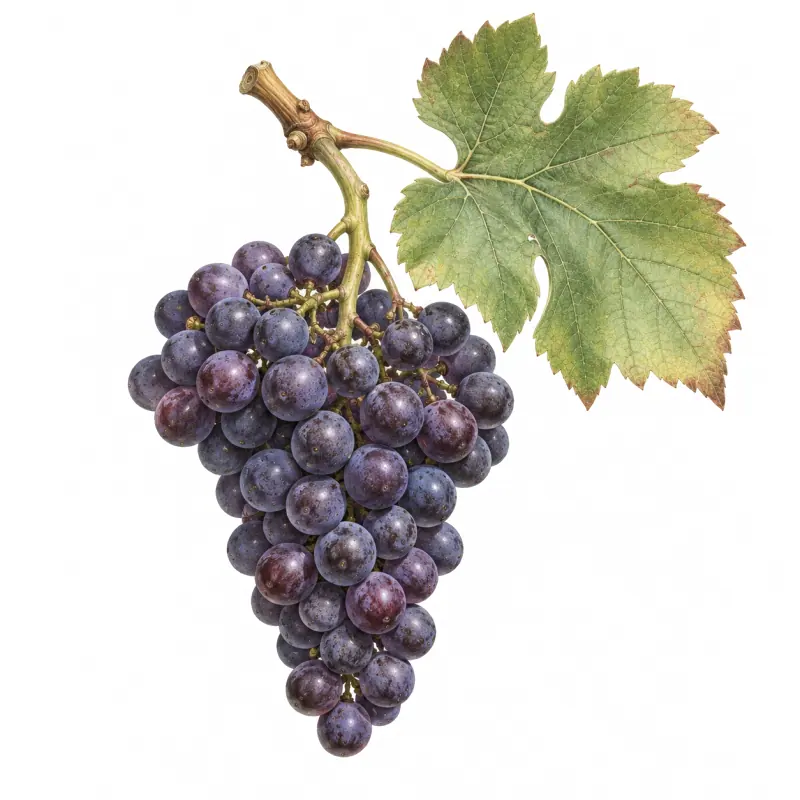
From Roman vines to the first cooperatives
The German Wine Institute says the Romans already valued the climate of the Ahr valley and planted its first vines. The oldest convent on the Ahr, the Augustinian nunnery of Marienthal near Dernau, was founded in 1137 and owned vineyards. Swedish troops plundered it in 1632 and French troops burned it in 1646; it was rebuilt from 1699 and dissolved in 1802 under Napoleon. In 1925 the estate became a Prussian state wine domain, and in 1952 part of its 19 ha became a Rhineland-Palatinate station for breeding new grape varieties.
From about 1860 the region was in deep crisis from failed harvests, phylloxera and the collapse of the wine trade. Growers responded by forming about 20 cooperatives by the end of the century. The Mayschoß cooperative had 141 members in 1881 and marked its centenary in 1968. Today 90% of Ahr growers belong to three cooperatives. The name Ahr was approved nationally by an order of 7 January 1936 and has been protected in the EU since 18 September 1973.
A narrow slate valley in the Eifel
The region lies in the Rhenish Slate Mountains, in the northern part of the Eastern Eifel. Vines grow along about 18 km of the Ahr between Altenahr and Bad Neuenahr, in the communes of Ahrbrück, Altenahr, Dernau, Grafschaft, Mayschoß, Rech and Bad Neuenahr-Ahrweiler. The valley floor lies at about 150 m in the west and 100 m in the east. It is 50–150 m wide in the west and 200–250 m wide between Rech and Dernau, with steep to very steep sides 150–200 m high. In the east vines grow mainly on gentle slopes and on the flats of higher river terraces, except on the steep Lohrsdorfer Kopf and Landskrone. Of the whole vineyard, 69% has a gradient above 30%.
The whole area sits on the Ahr anticline: Lower Devonian greywacke with some clay slate, hard and grey in the west, deeply weathered and often multicoloured in the east. Gravels and loams of the valley floor and terraces are widespread, often under thick loess. Small plots and steep slopes limit mechanisation.
Dense reds from slate and greywacke
The specification says that the different weathered soils give Ahr wines their character. Its red wine is light to dark ruby, with fruit recalling blueberries, dried fruit, strawberry and cherry, and a taste of particular density. Rosé is pressed light from red grapes, pale to light red, fresher and less alcoholic than the red, with less tannin. White wine is pale green to yellow, recalls peach and citrus, and has clearly perceptible acidity. The specification links this typology to the long growing season, the steep topography, local microclimates and the soils, which give the varieties fine but clear aromas and flavours. It credits the dominant slate and greywacke soils with a high minerality.
The Ahr designation and its grades
Ahr is a protected designation of origin (PDO-DE-A0867) for wine, quality sparkling wine and semi-sparkling wine. Its labels may use Qualitätswein, Prädikatswein, Sekt b.A., Winzersekt, Qualitätsperlwein, Weißherbst, Classic and Riesling-Hochgewächs, and the name may be completed by a smaller geographical unit; the region has 40 single vineyards (Einzellagen). In 2025 Spätburgunder covered 347 ha, or 64.9% of the vines, and the German Wine Institute names Frühburgunder as a regional specialty, with Dornfelder, Portugieser, Müller-Thurgau and Riesling also grown.
Minimum must weights run from 55 °Oe for Riesling Qualitätswein to 150 °Oe for Trockenbeerenauslese, and the maximum yield is 100 hl/ha. Under the Wine Act a Prädikat is granted only to unenriched wine: Spätlese needs fully ripe grapes from a late harvest, Auslese fully ripe or nobly rotten grapes, Beerenauslese and Trockenbeerenauslese hand-picked overripe or nobly rotten berries, and Eiswein grapes frozen when picked and pressed. Every wine must pass an official test and show its test number (AP number).
Classification
- QualitätsweinMinimum must weight 55 °Oe for Riesling, 65 °Oe for Weißburgunder, Ruländer, Frühburgunder, Müllerrebe and Spätburgunder, 68 °Oe for Dornfelder and 60 °Oe for other varieties. May be enriched to 15% vol. Maximum yield 100 hl/ha.
- PrädikatsweinNever enriched. Kabinett at least 76 °Oe (white) or 80 °Oe (red); Spätlese 80–87 °Oe (white) or 85 °Oe (red); Auslese 88–93 °Oe (white) or 90 °Oe (red); Beerenauslese and Eiswein 110 °Oe; Trockenbeerenauslese 150 °Oe.
- Sekt b.A. and WinzersektAt least 51 °Oe for Riesling and 57 °Oe for other varieties; bottle-fermented Sekt must spend at least 9 months in bottle.
How it connects
Wine region
- in Germany
Grape variety
- grows Pinot Noir
Continue exploring
- CountryGermany20 entries in the atlas so far
- Grape varietyPinot Noir
 RecipeBaeckeoffeAlsace, France
 RecipeBœuf bourguignonDijon, France
 RecipeCoq au vinBurgundy, France
- Wine regionGermanyGermany
 RecipeŒufs en meuretteBurgundy, France
 StoryThe Cistercians and the Clos de VougeotVougeot, France
 StoryDid Dom Pérignon invent Champagne?Hautvillers, France
- Wine regionAlto AdigeBolzano, Italy