
Wine · Wine region · Short entry
Württemberg
Württemberg
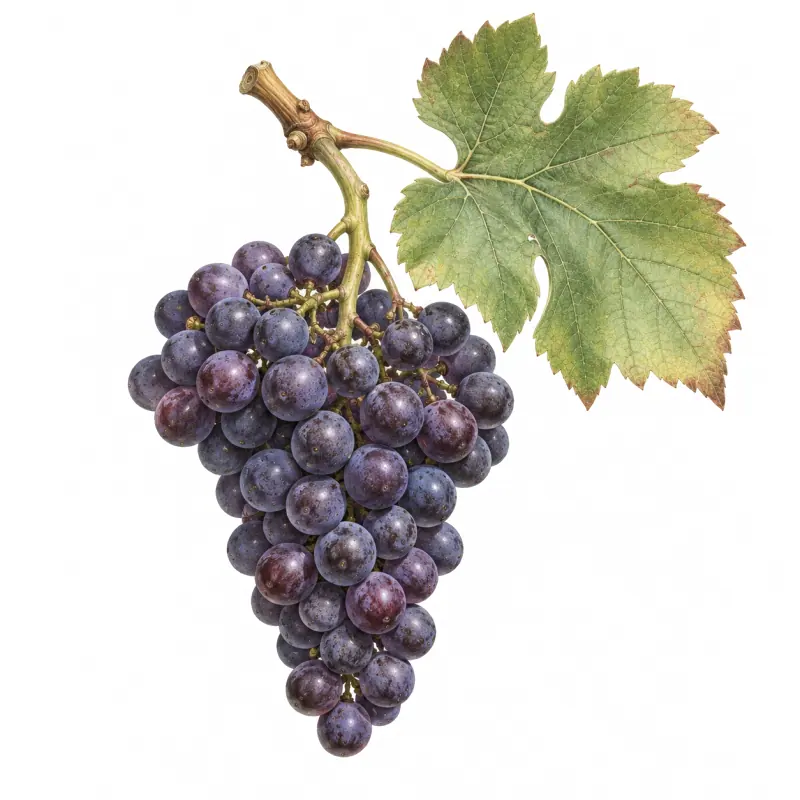
Württemberg is Germany's fourth-largest wine region, with 10,694 ha of vines in 2025 along the Neckar and its tributaries Rems, Enz, Kocher, Jagst and Tauber, and a small area by Lake Constance. Red grapes cover 65% of the vineyard; Trollinger and Lemberger are its signature varieties and Riesling its main white. More than 50 growers' cooperatives sell about 80% of its wine.
Societies, cooperatives and the first Sekt
On 23 January 1825, 22 men met in Stuttgart to found a society for improving wine in Württemberg, which became the Württemberg wine-growers' association. In 1855 growers at Neckarsulm formed what the association calls the oldest documented growers' union in Germany. On 1 July 1826 Georg Christian von Kessler, who had worked for Veuve Clicquot in Champagne from 1807, founded Germany's first sparkling-wine house at Esslingen. His first 4,000 bottles were made from Frühburgunder and sold as 'schäumender Württemberger Wein'.
The association was dissolved by force on 1 February 1935 and refounded at Heilbronn on 24 November 1947 for Württemberg and north Baden; the north Baden section left on 31 December 1964. The name Württemberg was approved by an order of 7 January 1936 and has been protected in the EU since 18 September 1973. A 2017 amendment corrected the commune list and added varieties, citing small, very steep and terraced walled vineyards and climate change.
Muschelkalk slopes and Keuper hills
The region runs from Weikersheim near Bad Mergentheim to Metzingen east of Tübingen: from the Kocher-Jagst-Tauber district, next to Franken, along the Neckar past Heilbronn and Stuttgart. A small area by Lake Constance between Friedrichshafen and Lindau belongs to it, partly in Bavaria. The Kocher and Jagst have cut deep into the Muschelkalk of the Hohenlohe plain, and their steep slopes show stony, fossil-rich soil; the rest of Hohenlohe has reddish Keuper marls. The Neckar, with its sun-warmed, shallow, stony Muschelkalk slopes, is the main artery; loess and Gipskeuper soils are also planted. The share of steep sites is high.
The specification gives altitude and climate by district: 180–380 m, 9.5–9.8 °C and 550–650 mm in Tauber-Jagst-Kocher; 150–250 m, 10.0–10.5 °C and 700–900 mm on the lower Neckar; 300–430 m in the Remstal; 400–510 m on the upper Neckar; and 400–500 m with 1,000–1,050 mm by Lake Constance.
Late grapes ripened on warm, dry slopes
The specification says the steep sites, with their extreme warm, dry climate, let even late-ripening varieties reach full ripeness, and that vintage weather and varied soils give wines marked by aroma and fruit. It describes Württemberg white as greenish to golden yellow with perceptible fruit and acidity, and red as ranging from light red through brick, ruby, garnet and purple to near black, with perceptible tannin. Rosé is lighter and fresher than red, with less tannin. In the northern Kocher-Jagst-Tauber district, rougher autumn weather favours early white varieties, which give lighter, acid-rich whites the specification calls lively, filigree and elegant.
Trollinger, Lemberger and Schillerwein
Württemberg is a protected designation of origin (PDO-DE-A1276) for wine, liqueur wine, quality sparkling wine and semi-sparkling wine, from districts of Baden-Württemberg between Main-Tauber and the Bodensee and from Lindau, Nonnenhorn, Wasserburg and Bodolz in Bavaria. In 2025 red varieties covered 6,721 ha: Lemberger 1,661 ha, Trollinger 1,614 ha, Spätburgunder 1,242 ha and Schwarzriesling 1,030 ha. Riesling, on 1,995 ha, makes about half the white wine. The region has 210 single vineyards.
Schillerwein is the local name for a Rotling, a pale to light red Qualitätswein from white and red grapes, also made as Schillersekt. Labels may also use Weißherbst, Blanc de Noirs, Classic and Riesling-Hochgewächs. The maximum yield is 110 hl/ha, or 150 hl/ha on registered steep sites. A Prädikat is granted only to unenriched wine, and every wine except Federweißer carries an official test number.
Classification
- Qualitätswein and PrädikatsweinMust weights are set by variety in Baden-Württemberg; Beerenauslese and Eiswein need at least 124 °Oe and Trockenbeerenauslese 150 °Oe. Maximum yield 110 hl/ha for normal sites and 150 hl/ha for registered steep sites, each plus a 20% carry-over; 110 hl/ha in Bavaria.
- ClassicA single-variety red or white Qualitätswein of a typical grape, at least 1% vol above the minimum natural alcohol, at least 11.5% vol in total, with no more than 15 g/l of sugar and no taste indication.
How it connects
Wine region
- in Germany
Grape variety
- grows Pinot Noir
Continue exploring
- CountryGermany20 entries in the atlas so far
- Grape varietyPinot Noir
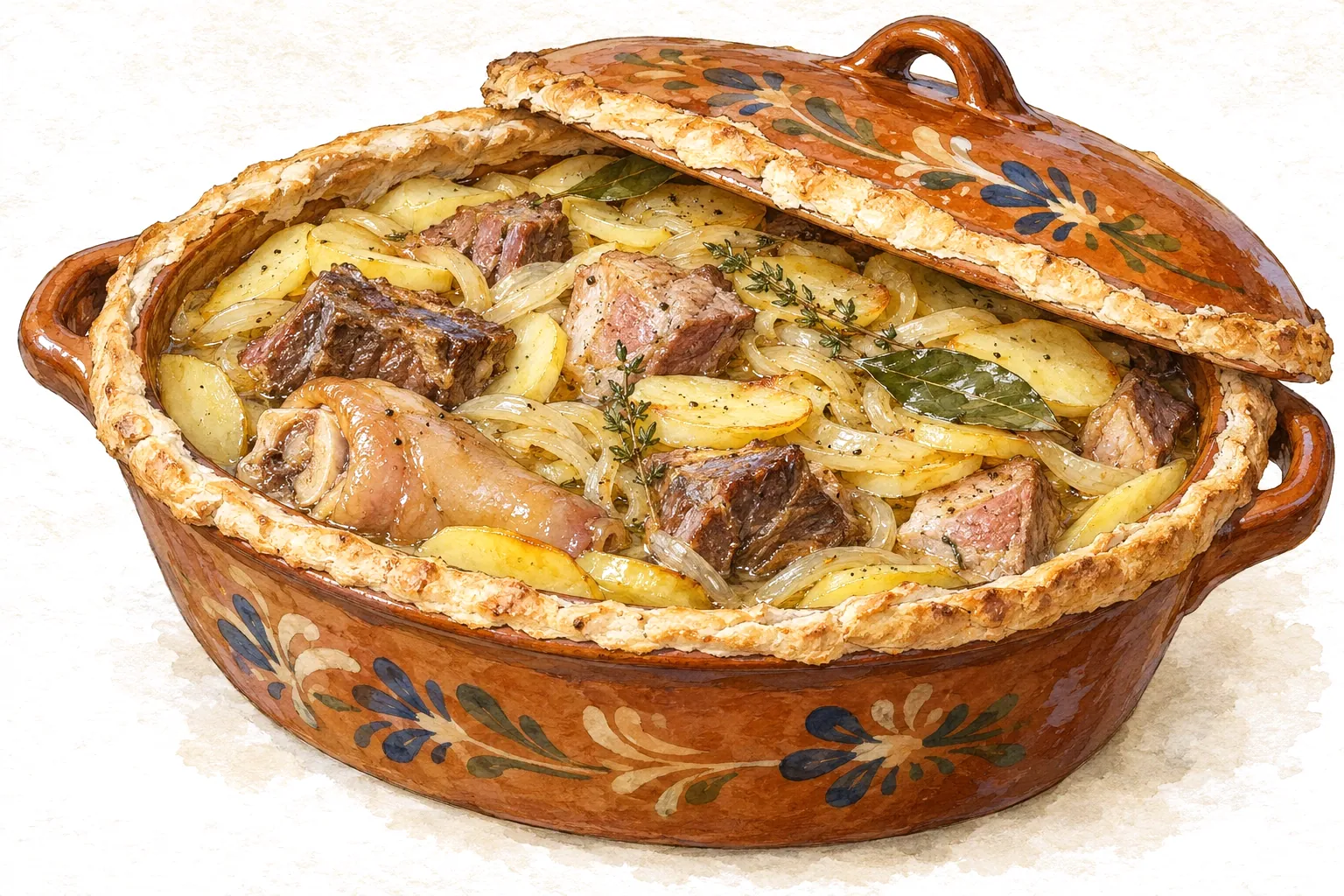 RecipeBaeckeoffeAlsace, France
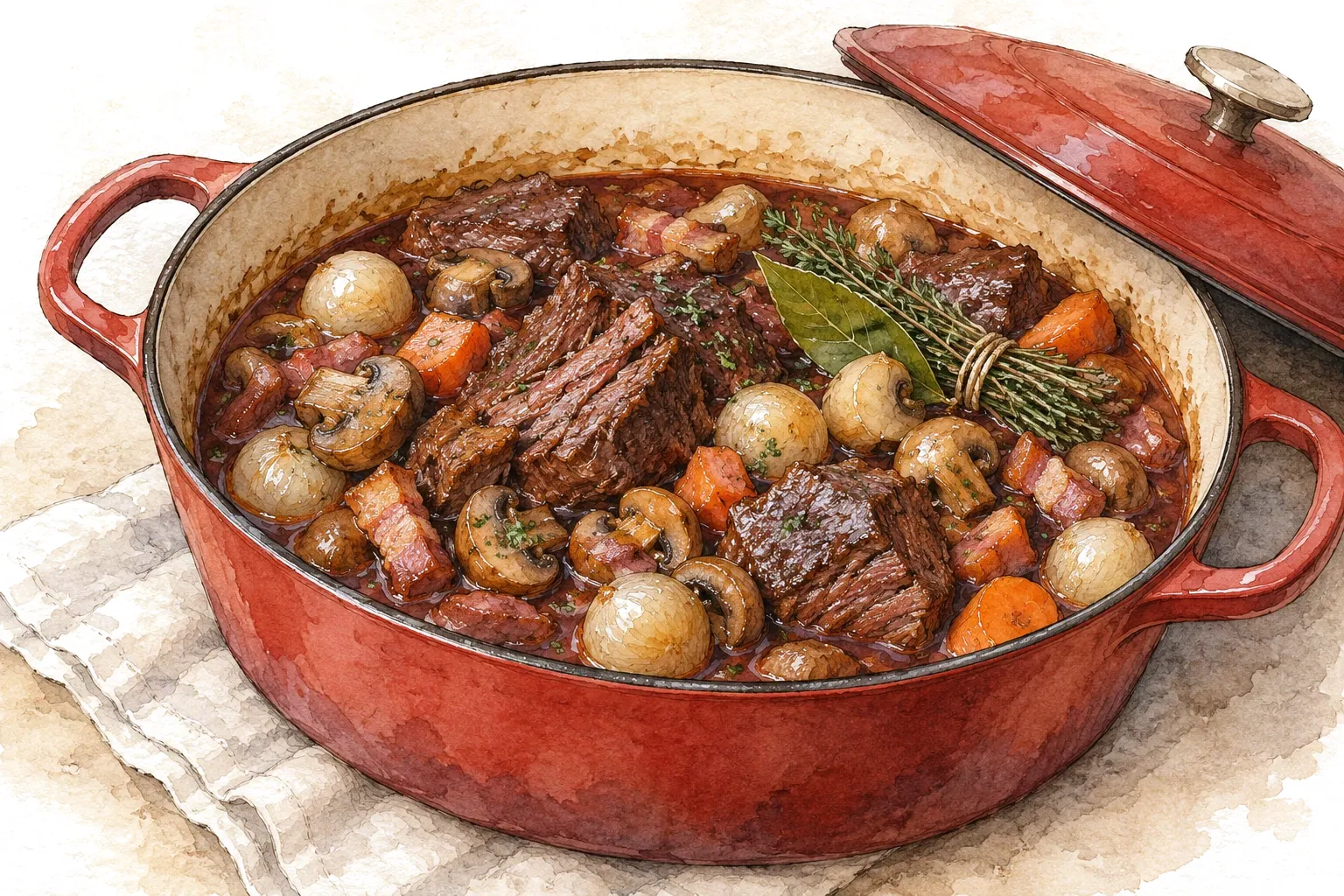 RecipeBœuf bourguignonDijon, France
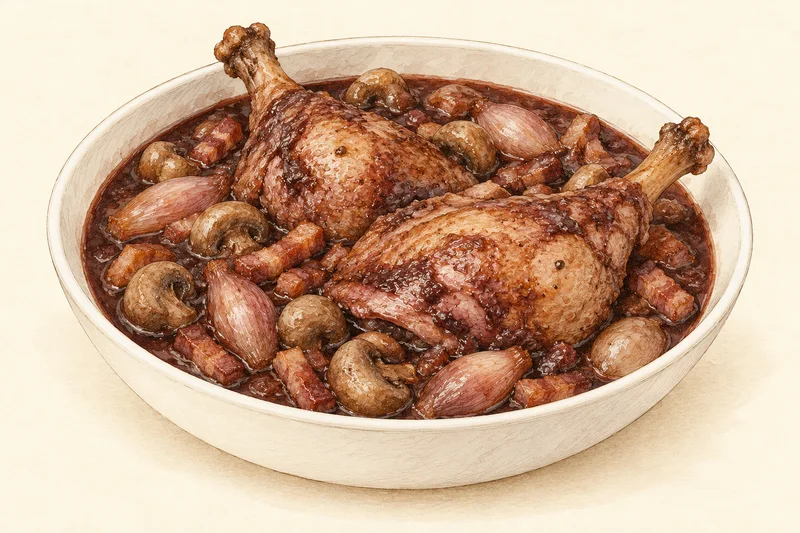 RecipeCoq au vinBurgundy, France
- Wine regionGermanyGermany
 RecipeŒufs en meuretteBurgundy, France
 StoryThe Cistercians and the Clos de VougeotVougeot, France
 StoryDid Dom Pérignon invent Champagne?Hautvillers, France
- Wine regionAlto AdigeBolzano, Italy