Wine · Wine region · Short entry
Peru
Peru grows vines mainly in the desert valleys of its Pacific coast, which hold 97.5% of an estimated 12,000 ha, with Lima and Ica producing 87% of the grapes. ICEX's 2025 study gives 19.2 million litres of wine in 2024, more than half of it from Ica. The country's only protected grape name is Pisco, a grape spirit recognised as Peru's first denomination of origin on 12 December 1990.
Lima's first vines and the Pisco denomination
The researcher Guillermo Toro-Lira, as reported by Peru's state news agency in 2018, found documents showing that Captain Hernando de Montenegro planted a vineyard in Lima between 1539 and 1541; a 1556 probanza has witnesses saying it supplied cuttings to Huamanga, Arequipa, Cusco and Chile. Toro-Lira dates the first wine made in Lima to 1551, when a Lima-Potosí trade began, and thinks the first vines were very probably Listán Prieto. In 2024 the national archive presented manuscripts of 1583 and 1587 recording grape spirit and wine in the Ica region. Pisco was declared Cultural Heritage of the Nation in 1988 and recognised as the first Peruvian denomination of origin on 12 December 1990; Decreto Supremo 001-91-ICTI/IND gave it full recognition. In 2011 Indecopi approved the DO regulation and a producers' regulatory council, whose authorisation it cancelled in October 2024.
Desert valleys cooled by the Humboldt current
A 2012 study by Beatriz Hatta Sakoda and Jorge Tonietto, citing Peru's meteorological service, explains that Peru lies in the tropics but has subtropical climates because of the Andes and the Humboldt and El Niño currents; the cold Peruvian current keeps the coast temperate and humid. About 97.5% of the vines are on the coast, 1.5% in the highlands and 1% in the jungle. The main coastal valleys have a semi-warm, very dry climate, desert, arid and subtropical, that covers the coast from Piura to Tacna up to about 2,000 m: mean annual rainfall of about 150 mm and temperatures of 18-21 °C, with winter fog and humidity of 90-98% near the sea and drier valleys inland. Heat accumulation ranges from 1,500 to 3,400 degree-days. At Cañete, south of Lima, rainfall is only 11.4 mm a year. The authors note that Peruvian vineyards lack enough winter cold for the desired dormancy.
Hot, dry valleys and sweet wines
Hatta Sakoda and Tonietto classify the viticultural climate of Cañete as hot, with warm nights and strong drought, and that of Ica as hot, with temperate nights and strong drought. They distinguish fine wines from a few industrial wineries, artisanal wines for local consumption and piscos made mostly by small producers. ICEX reports that about 90% of wine drunk in Peru is still inexpensive sweet wine, with a shift towards dry wines among wealthier consumers. No Peruvian authority publishes a sensory profile for coastal wines.
Wine without appellations; Pisco with one
No wine appellation system was found for Peru; the only grape-based denomination is Pisco. Indecopi defines it as the product obtained only by distilling fresh, recently fermented musts of pisco grapes, in copper stills, without added water, sugar or other substances, using traditional methods. Eight varieties are allowed: Quebranta, Negra Criolla, Mollar, Italia, Moscatel, Albilla, Torontel and Uvina. Pisco may be made only on the coast of Lima, Ica, Arequipa and Moquegua and in the Locumba, Sama and Caplina valleys of Tacna, by producers authorised by Indecopi; there were 526 in 2019. Labels must show the DO, the authorisation number, the type, grape, valley and harvest year; double distillation is prohibited. The regulation incorporates technical standard NTP 211.001:2006. For wine, the 2012 study names Malbec, Merlot, Cabernet Sauvignon, Alicante Bouschet, Grenache, Barbera and Chenin Blanc in Ica and Quebranta, Italia, Barbera and Borgoña (Isabella) at Cañete. ICEX gives 13,000 ha and 19.2 million litres of wine in 2024.
Classification
- Denominación de Origen PiscoGrape spirit from eight pisco grapes, distilled on the coast of Lima, Ica, Arequipa and Moquegua and in three Tacna valleys; use requires an Indecopi authorisation.
How it connects
Wine region
- subregion Ica
Recipe
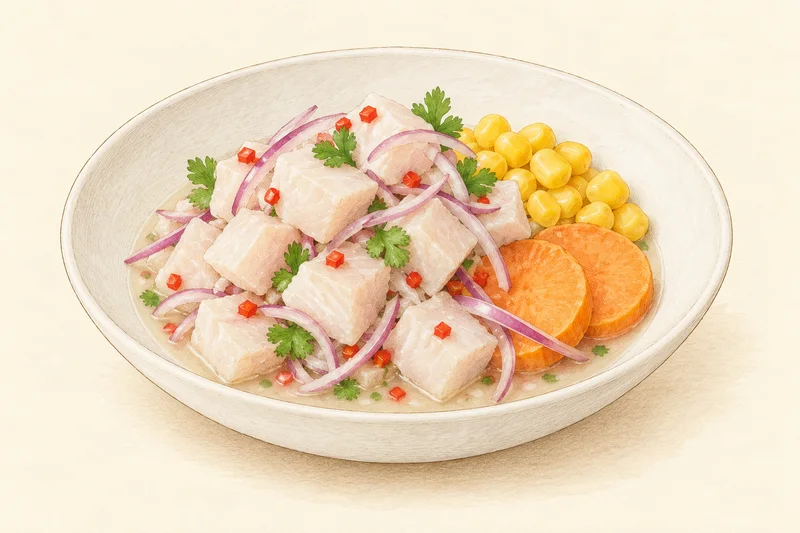
- origin Ceviche
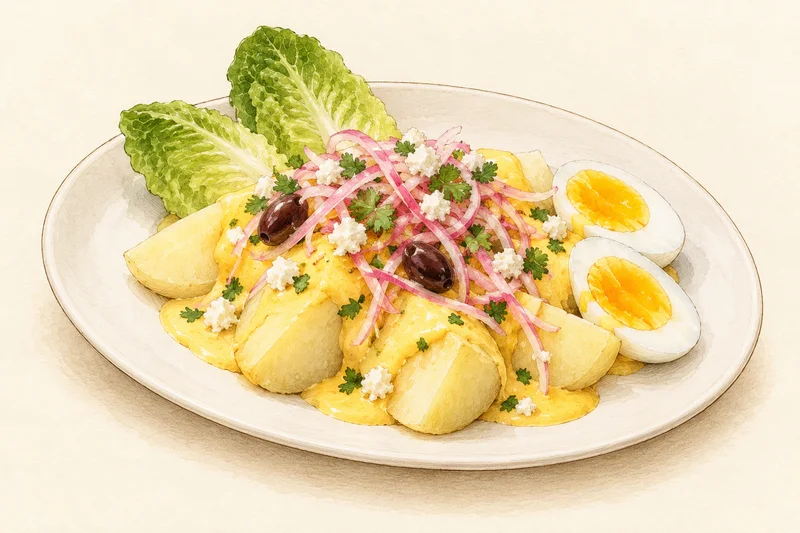
- pairs with Papas a la huancaína