
Wine · Wine region · Short entry
Vinho Verde
Vinho Verde
Vinho Verde is the designation of origin of north-west Portugal, between the Minho River, the Douro River and the Atlantic, with about 16,000 ha of vines below 700 m. Its nine subregions make white, rosé and red still wines and sparkling wines from mostly native grapes such as Alvarinho, Loureiro, Arinto, Avesso, Azal and Vinhão. The name does not require a wine to be young, fizzy or low in alcohol.
Early exports and the 1908 demarcation
The IVV dates vine growing in the region to Roman times and the oldest recorded use of the term "Vinho Verde" to 1606. The CVRVV notes that the region coincides with the birthplace of Portugal in the twelfth century. It says the first Portuguese wines to be exported left from here in the fourteenth century; the IVV says wines of Monção and the Ribeira Lima were going to England in the sixteenth. The specification says these were probably the first Portuguese wines known in the markets of England, Flanders and Germany. Red wines made the region's name; white wines from local grapes drew attention only in the late nineteenth century.
The region was demarcated on 18 September 1908. The CVRVV was founded in 1926. The OIV recognised the designation in 1949; the seal of origin dates from 1959 and WIPO registration from 1973. Research on native white grapes and on vine training in the 1960s and 1970s helped white wine displace red. The designation entered the EU register in 1991.
An amphitheatre open to the Atlantic
The specification sets natural limits: the Minho River to the north; the Douro and the Freita, Arada and Montemuro ranges to the south; the Peneda, Gerês, Cabreira and Marão ranges to the east; and the Atlantic to the west. The land forms an amphitheatre facing the ocean, cut by a dense network of river valleys that let sea winds far inland. The CVRVV names the Minho, Lima and Douro and the smaller Tâmega, Ave and Cávado. Vineyards lie below 700 m on shallow, mostly granite soils, with two narrow bands of schist; the IVV adds that they are sandy and acid.
The climate is mild, with rain averaging about 1,200 mm a year. Amarante, Baião and Basto, inland and higher, have wider temperature swings and suit late-ripening Azal, Avesso and Vinhão. Ave, Cávado and Sousa are lower, milder and more exposed to the sea. Lima, a wide valley open to Atlantic winds, is cool and wet. Paiva is sheltered and drier. Monção e Melgaço, in the north-east, has a sheltered microclimate with wide temperature swings and warmer, drier summers.
What the place gives the wine
The specification links mild temperatures, high rainfall, sea winds and shallow granite soils to gentle, balanced ripening. It names the results as aromatic richness, high freshness, balanced acidity and generally moderate alcohol. Each subregion stresses part of this. Wines of Amarante, Baião and Basto are higher in alcohol than the regional average, with moderate acidity and citrus, tropical and mineral notes. Ave, Cávado and Sousa give very fresh wines with floral, citrus and white-fruit aromas. Lima's whites and rosés are elegant and floral. Paiva gives reds of deep colour and good structure. In Monção e Melgaço the whites, mainly Alvarinho, are intense but elegant, full and mineral. The CVRVV says these can evolve in bottle for more than two decades.
Grapes, subregions and limits
DO Vinho Verde covers still wine, sparkling wine and quality sparkling wine, as well as grape spirit and vinegar. Whites must be made from white grapes and rosés from red grapes. Reds are made from red grapes, or with up to 15% white grapes if labelled palhete. The general list has about fifty grapes, almost all Portuguese and half of them native to the region. Each subregion has a shorter list. Monção e Melgaço allows Alvarinho, Alvarelhão, Borraçal, Loureiro, Pedral, Trajadura and Vinhão. Lima allows Arinto, Borraçal, Espadeiro, Loureiro, Padeiro, Trajadura and Vinhão. Wines without a variety, subregion or quality term are limited to 11.5% alcohol, and late-harvest wines need at least 45 g/l of sugar. Vines may be trained high in traditional systems such as ramadas on granite posts, or on modern cordons. Wines with a subregion, variety or quality term may be sold only in glass bottles of up to 0.75 litre.
Classification
- DO Vinho VerdeWine at 8-11.5% acquired alcohol unless it carries a variety, subregion or quality term; minimum 9% for subregion wines and 11.5% for wines labelled Alvarinho. Maximum yield 10,666 kg/ha, raised under conditions to 13,500 kg/ha for Alvarinho or 15,000 kg/ha for other grapes.
- SubregionsAmarante, Ave, Baião, Basto, Cávado, Lima, Monção e Melgaço, Paiva and Sousa, each with its own list of grapes; the vintage must be shown.
- IG MinhoRegional wine over the same area, with a wider choice of grapes.
How it connects
Recipe
Continue exploring
- CountryPortugal18 entries in the atlas so far
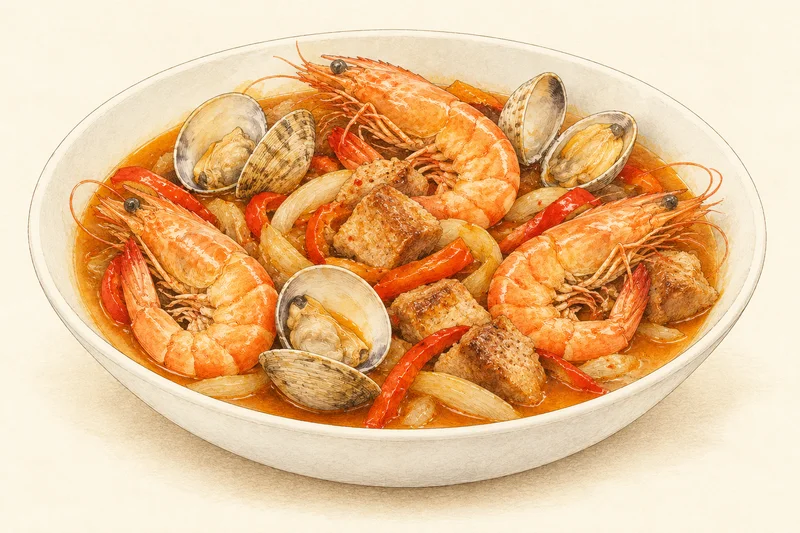 RecipeCataplana with pork and clams (cataplana à algarvia)Algarve, Portugal
- Grape varietyAlvarinho
- Grape varietyArinto
- Grape varietyLoureiro
- Wine regionAlentejoÉvora, Portugal
- Wine regionAlgarveLagoa, Portugal
- Wine regionBairradaAnadia, Portugal
- Wine regionLisboaBucelas, Portugal
- Wine regionRías BaixasCambados, Spain