
Wine · Wine region · Short entry
Kakheti
კახეთი
Kakheti, in eastern Georgia, is the country's most important wine region, according to the National Wine Agency. Its best vineyards lie in the Alazani and Iori basins at 400–700 m, and 19 of the 25 appellation wines the agency counts are Kakhetian, among them Tsinandali, Mukuzani, Kindzmarauli and Gurjaani. Saperavi is the most widespread grape.
A traditional type, registered appellations
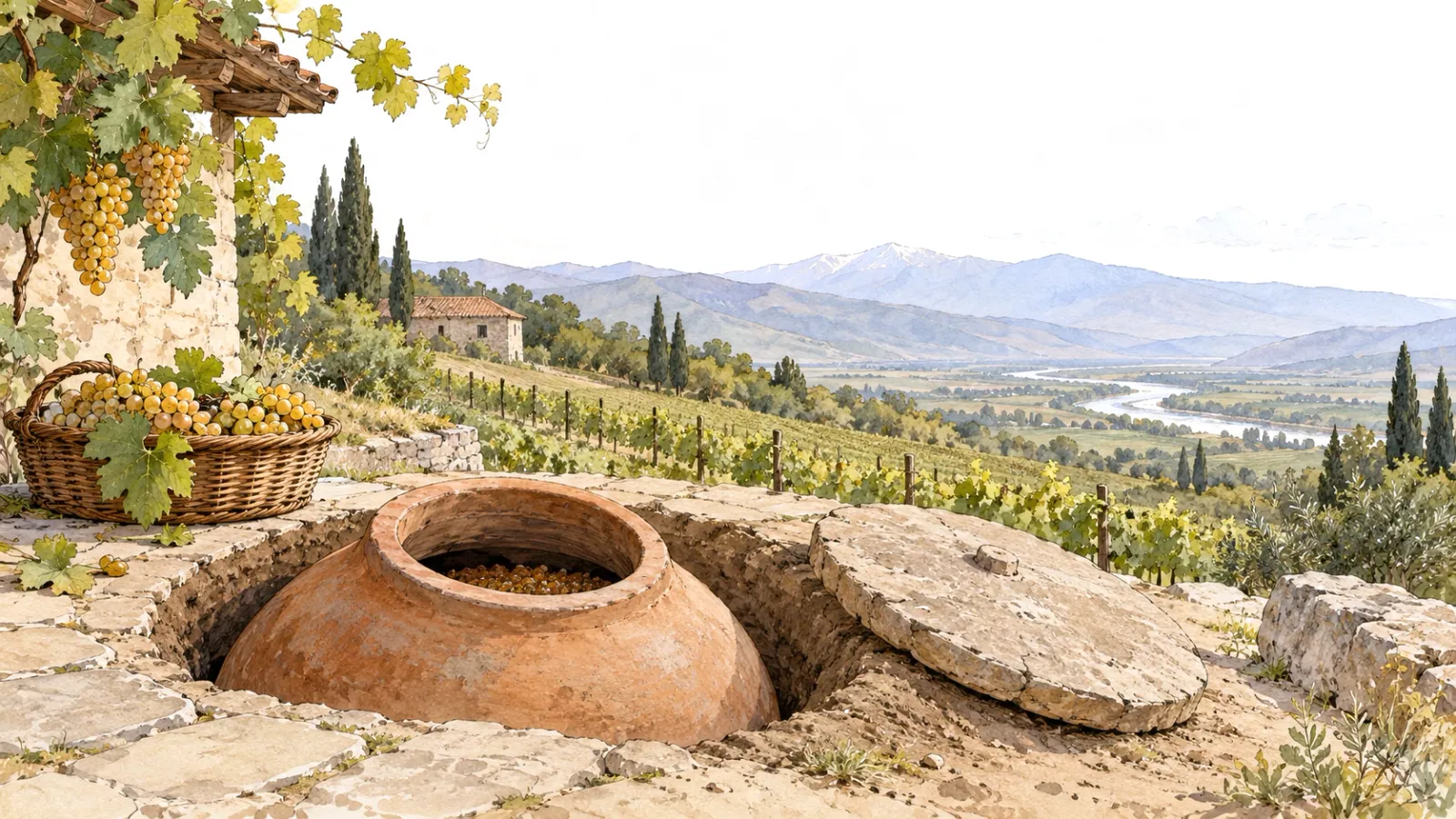
The National Wine Agency says Kakheti has for centuries created its own type of table wine, distinct from others in the world, and calls its traditional technology without analogy. The archaeological record is not Kakhetian: the Neolithic wine residues of about 6000–5800 BC described in PNAS in 2017 come from Kvemo Kartli, south of Tbilisi, and the same study dates the earliest evidence of qvevri winemaking in Georgia to the 8th–7th centuries BC. Kakhetian appellations were among the first registered in Georgia: Akhasheni, Gurjaani and Mukuzani on 30 August 2005, Manavi on 21 August 2006, and Vazisubani, Teliani, Kardenakhi, Kakheti and Napareuli on 10 December 2007. UNESCO listed the Georgian qvevri method in 2013.
Alazani and Iori basins
The agency places the vineyards that give Kakheti's best wines in the basins of the Alazani and Iori rivers, at 400–700 m, on humus-carbonate, black and alluvial soils. The appellation names are those of villages and areas in these basins, such as Tsinandali, Gurjaani, Vazisubani, Manavi, Kardanakhi, Tibaani, Kotekhi, Napareuli, Mukuzani, Teliani, Kindzmarauli, Akhasheni, Kvareli, Akhoebi, Tsarapi and Khashmi, with Akhmetis Mtsvane, Kisi Magraani and Kakheti itself. In Kakheti, the agency says, qvevri are buried in the cellar, where they keep a steady 13–15 °C during fermentation. The agency's pages give no rainfall or temperature figures for the region.
Tannic, extracted, soil-marked
The National Wine Agency says that among Georgian wines Kakhetian wine expresses soil properties most of all. It describes the traditional Kakhetian type as highly extracted, with a high content of phenolic compounds and tannins, a pleasant bouquet and the aroma and taste of the variety. White wines kept on their skins until spring are described as dark straw, golden or tea-coloured, fruity, moderately tannic and naturally stable. Saperavi, the most widespread variety, is used for qvevri and European-style reds and also for rosé and sparkling wines.
Nineteen appellations and the Kakhetian method
The agency counts 19 Kakhetian appellations among Georgia's 25: Tsinandali, Gurjaani, Vazisubani, Manavi, Kardanakhi, Tibaani, Kakheti, Kotekhi, Napareuli, Mukuzani, Teliani, Kindzmarauli, Akhasheni, Kvareli, Kisi Magraani, Akhoebi, Tsarapi, Akhmetis Mtsvane and Khashmi. In the Kakhetian method grapes are pressed in a satsnakheli (wine press) and the must poured into qvevri with all the chacha (skins, stalks and pips). After fermentation the chacha sinks, the qvevri are closed, and after malolactic fermentation sealed hermetically; the first racking is in March and the wine then ages for about a year. European methods are used too: classic Tsinandali is made from Rkatsiteli and Kakhuri Mtsvane. The agency names Rkatsiteli, Kakhuri Mtsvane, Kisi, Khikhvi, Budeshuri, Mtsvivana, Sapena, Kunsi, Saperavi, Cabernet Sauvignon, Tavkveri and Ikalto Red among the region's grapes.
Classification
- Appellation of origin (PDO)19 Kakhetian appellations, including Akhasheni, Gurjaani and Mukuzani (registered 2005) and Manavi (2006).
How it connects
Wine region
- in Georgia
Story
- related Georgia's qvevri
Continue exploring
- CountryGeorgia3 entries in the atlas so far
 StoryGeorgia's qvevriGadachrili Gora (Kvemo Kartli), Georgia
- Wine regionGeorgiaGeorgia (national overview), Georgia
- StoryFruit: from the apple forests of the Tian Shan to the banana boatKazakhstan
- StoryOther drinks: mead, cider, rice wine, palm wine, cacao and spa waterPeople's Republic of China