
Wine · Living tradition · Reference page
Georgia's qvevri
In Georgia wine is still fermented in large egg-shaped clay jars buried in the ground, a practice UNESCO listed as intangible heritage in 2013. Residues in Neolithic pottery show that people in the same country were making grape wine around 6000 BC, though nobody yet knows whether those first jars were buried.
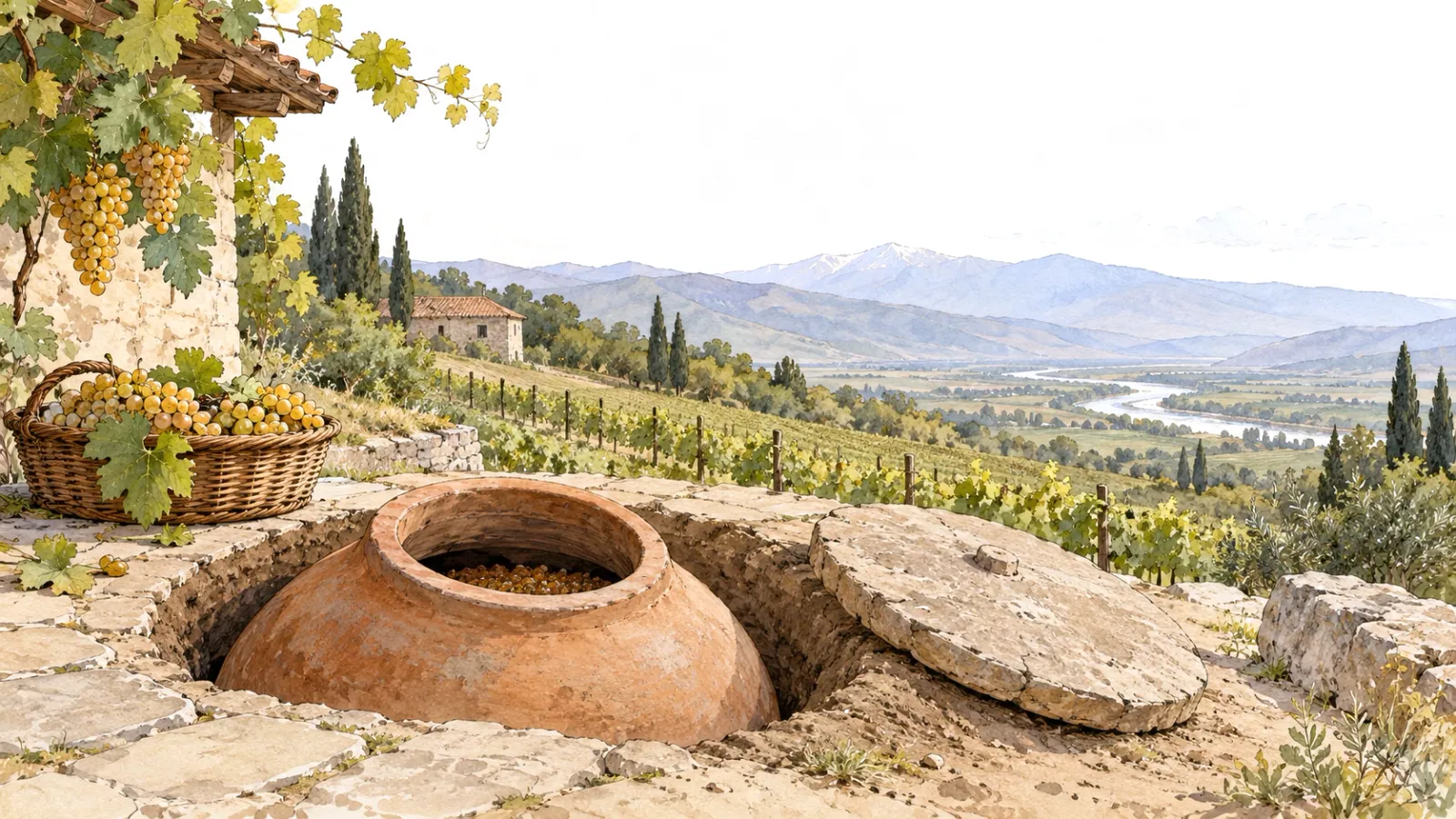
A jar in the ground
A qvevri is an egg-shaped earthenware vessel used to make, age and store wine. In the traditional method the grapes are pressed and the juice is poured into the qvevri together with the skins, stalks and pips. The vessel is sealed and buried in the ground, and the wine ferments and settles there for five to six months before it is drunk. The earth keeps the temperature steady.
UNESCO inscribed the "Ancient Georgian traditional Qvevri wine-making method" on its Representative List of the Intangible Cultural Heritage of Humanity in 2013. The listing describes a practice found throughout Georgia, especially in villages that grow their own grape varieties, and handed down within families: children learn to tend vines, press grapes, ferment wine, and also to collect clay and make and fire the jars, by watching their elders. Most farmers and city dwellers use this method. The wine cellar is still called the holiest place in the family home, and vines and wine run through Georgian songs and oral tradition. Wine is part of everyday life and of secular and religious celebrations alike.
Kakheti and Imereti
Two broad styles are described. In Kakheti the juice ferments with up to all of its chacha, the skins, seeds and stalks. In Imereti only a small share of chacha is added, about 2.5 to 3 %. Primary fermentation takes 10 to 20 days with the jar left open so that the cap of skins can be pushed down; the qvevri is then closed for a maturation that can last from one to several months.
Long contact with skins and seeds changes the wine, white or red: studies of Georgian wines find higher total phenolic content in qvevri-made wines than in wines made the conventional European way. In the analyses gathered by a 2026 review, qvevri wines generally contain more catechin, and qvevri reds more kaempferol and malvidin-3-O-glucoside. The country has a large reservoir of grapes to draw on: the same review counts 525 native varieties, white, black, red, pink and grey.
Eight thousand years?
Georgia's wine is often called the oldest in the world. The strongest evidence comes from a 2017 study led by Patrick McGovern. The team analysed residues absorbed into pottery from two early Neolithic villages, Shulaveris Gora and Gadachrili Gora, about 2 km apart in Kvemo Kartli, some 50 km south of Tbilisi. They found tartaric acid, the main chemical marker of grape in the region, together with malic, succinic and citric acids, and grape pollen, starch and skin fragments supported the result. The wine dates to about 6000 to 5800 BC, roughly 8,000 years ago, which the authors describe as the earliest biomolecular evidence of grape wine from the Near East. The previous record for the region was Hajji Firuz Tepe in the Zagros Mountains of Iran, about 5400 to 5000 BC.
The villages belong to the Shulaveri-Shomutepe culture, about 5900 to 5000 BC: small settlements of closely spaced round mudbrick houses whose people farmed recently domesticated plants such as barley and einkorn wheat, in a period of milder, better-watered conditions. Clay strips and globules were sometimes applied to the outside of jars, and one motif has been read as a schematic bunch of grapes. Whether the grapes themselves were wild or domesticated is, the authors write, not yet clear.
The jars were large; one from a comparable site, Khramis Didi-Gora, is nearly a metre tall and wide and held more than 300 litres. The authors think such jars served for fermenting, ageing and serving. But they are careful on the point that matters most to the qvevri story: there is no evidence yet of how these Neolithic jars stood, and so no proof that they were buried. They suggest that wine, then as in Georgian wine culture today, probably also served as a medicine. The earliest archaeological evidence of qvevri winemaking itself in Georgia is from the Iron Age, the eighth to seventh centuries BC.
Reading the claim carefully
Three statements are often run together, and they rest on different evidence. That Georgians make wine in buried clay jars today, and have done so for a long time, is documented and recognised by UNESCO. That people in what is now Georgia were making grape wine around 6000 BC is the interpretation of careful chemical work, the current scholarly view. It is not the oldest wine of any kind: the same authors credit Jiahu in China, about 7000 BC, with the earliest chemically confirmed grape wine, in a mixed drink with hawthorn fruit, rice and honey. Georgia holds the record for the Near East. That the qvevri method itself is 8,000 years old goes further than the evidence: the Neolithic jars are wine jars, but the buried qvevri is securely documented only from about 2,700 years ago.
None of this makes the tradition less remarkable. A technique that is at least Iron Age in origin, still practised in family cellars and passed on by hand, is one of the longest continuous threads in the history of wine.
How it connects
Wine region
- related Kakheti
Continue exploring
- CountryGeorgia3 entries in the atlas so far
- StoryFruit: from the apple forests of the Tian Shan to the banana boatKazakhstan
- StoryOther drinks: mead, cider, rice wine, palm wine, cacao and spa waterPeople's Republic of China
- StoryA history of beer
- Wine regionKakhetiTelavi, Georgia
 RecipeWiener ApfelstrudelVienna, Austria
 RecipeChocolate mousseBelgium
 RecipeTarte TatinLamotte-Beuvron, France
- StoryCoffee: from Ethiopian forests to the world's cafésEthiopia
- StoryTea: from the hills of southern China to the world's cupPeople's Republic of China