Wine · Wine region · Short entry
Frascati Superiore
Frascati Superiore
A DOCG for white wine from the northern slopes of the Alban Hills, the volcanic Castelli Romani south-east of Rome, made mainly from Malvasia. Its zone includes Frascati, Grottaferrata, Monte Porzio Catone and parts of Rome and Montecompatri. It became a DOCG in 2011, from the Frascati DOC of 1966, and may also be made as a Riserva.
Tusculum, Cato and the statutes of 1515
The rules date viticulture here to Roman times, when the area was called Tusculum. A wall painting of the fifth century BC showing two goats under a laden vine, from Tusculum, has been kept since 1940 in the castle of Agliè in Piedmont. Cato the Censor, from a Tusculan family of growers, set rules for growing and winemaking in De Agricultura, and Varro recorded the Tusculan Vinalia and a law that no new wine be sent to Rome before the feast. A bull of Pope Sergius I (687-701) mentions vineyards below Frascati.
The town statutes of 1515, granted by Marcantonio Colonna, set aside land for vineyards, fixed the harvest date and regulated the wine trade. Sante Lancerio, bottler to Pope Paul III, rated the wines of Frascati, Marino and Grottaferrata the best. On the zone delimited by ministerial decree of 2 May 1933, Frascati became a DOC by decree of 16 May 1966, and Frascati Superiore a DOCG by decree of 20 September 2011.
Ash and tuff of the Latium Volcano
The zone, about 8,300 ha, lies on the northern slopes of the Alban Hills. The Latium Volcano began about 600,000 years ago with a central cone more than 2,000 m high, whose collapse formed a great caldera. Later explosions made craters: the older ones (Ariccia, Pantano Secco, Prata Porci) are now farmed, the younger hold the lakes of Albano and Nemi. Eruptions went on until 29,000-25,000 years ago. The deposits are mainly ash and lapilli. Loose pozzolane, locally 'terrinelle', give deep, sandy, free-draining soils; stony tuffs such as cappellaccio cover most of the area and need deep ripping before planting; lavas cover little land near the craters; and recent alluvium gives deep, clayey, often damp soils on the flat.
Vineyards lie at 70-500 m, generally facing west and north-west, on permeable volcanic soils, dry but not arid. Rain is 822-1,010 mm, with 84-127 mm in summer, and the mean temperature 13.7-15.2 °C.
Fresh, floral and velvety
The rules link the wine to the northern slopes of the volcano, whose west and north-west exposure makes the land airy and bright, with soils that shed water; low-lying land is excluded. Pozzolane, silts and yellow sands with pebbles, lake clays and terre rosse all suit quality, and the climate has plenty of rain but dry summers. The rules describe both Superiore and Riserva as fresh and balanced, straw yellow, with an intense, characteristic and delicate scent with floral notes, and a dry, sapid, soft, fine and velvety taste, with normal acidity, a barely perceptible bitterness, little astringency and good structure.
Malvasia first
Frascati Superiore needs at least 70% Malvasia bianca di Candia and/or Malvasia del Lazio (Malvasia puntinata). Bellone, Bombino bianco, Greco bianco, Trebbiano toscano and Trebbiano giallo may make up 30%, and other white grapes suited to Lazio no more than 15% of that 30%. Only well-placed vineyards on permeable volcanic soils qualify, with at least 3,000 vines/ha. The Riserva matures at least 12 months from 1 November of the harvest year, 3 of them in bottle. Bottles must hold 375-750 ml and close flush with the neck. Frascati DOC and Cannellino di Frascati DOCG are related but separate denominations.
Classification
- Frascati Superiore DOCGBottles of 375-750 ml with flush cork closure. The rules quote 77 hl/ha.
- RiservaAt least 12 months' maturation from 1 November of the harvest year, 3 in bottle.
How it connects
Recipe
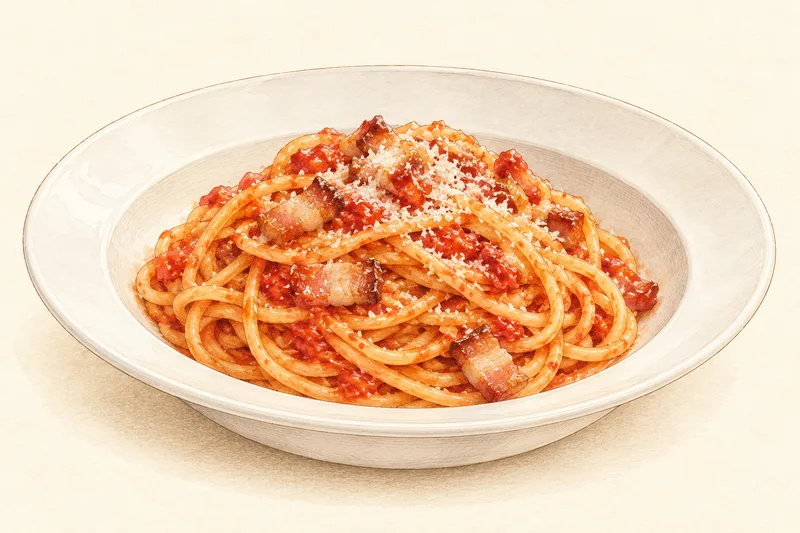
- pairs with Spaghetti all'amatriciana
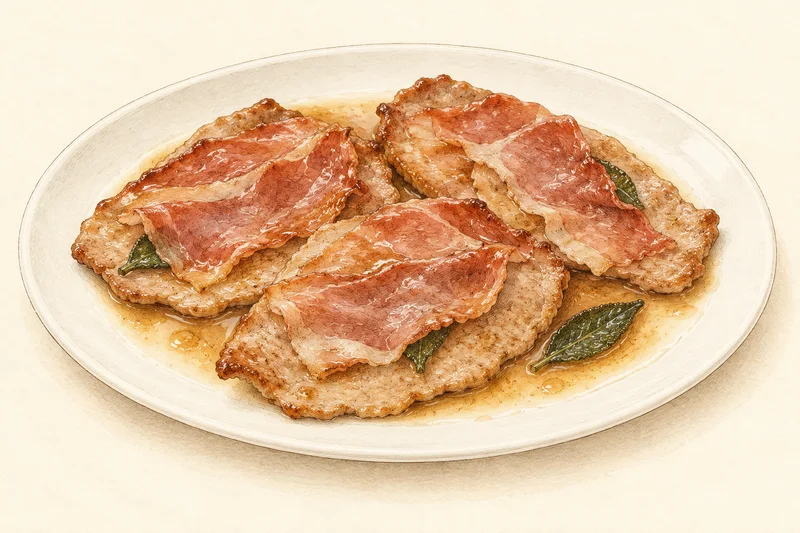
- pairs with Saltimbocca alla romana